
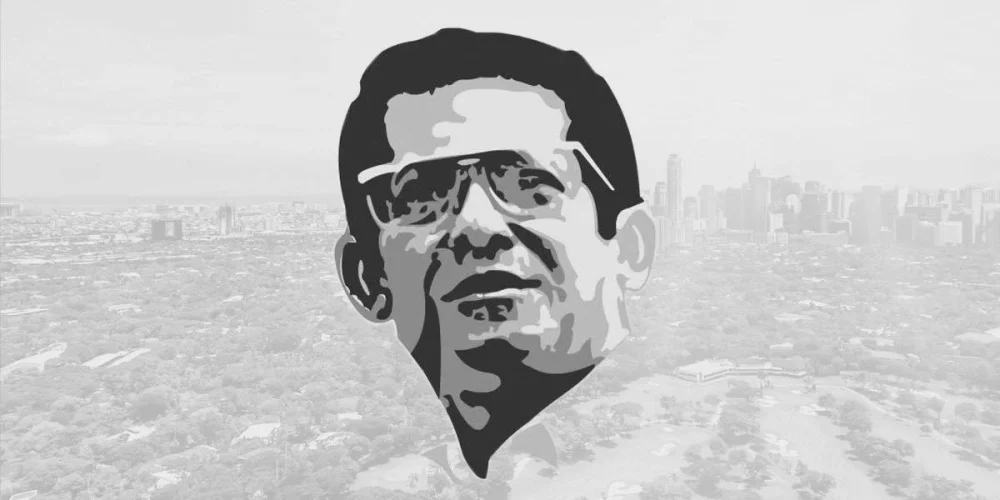
By Benigno S. Aquino, Jr.
Quezon City, MM
Reprinted from Foreign Affairs, July 1968 (Vol. 46, No. 4)
Part I of II
A diplomat, after a seven-year tour of duty in the Philippines, once christened the islands an “enchanting archipelago.” Whether he was merely being polite, or had succumbed to government pitchmen, or had himself become enchanted by the lush tropical beauty of the islands, he should also have seen a country wracked by afflictions, some common to all countries engaged in the desperate race to develop, some peculiar to the Philippines.
Purveyors of the rosy picture continue to roll out endless statistics and charts to depict a growing economy, a country on the move. A portion of this view may even be accepted, considering that the Philippines, with all its imperfections, is only 21 years old as a free republic. The trouble is that there is one vital natural resource that has not been properly developed: the people.
Beneath the outpourings of self-serving government data, hidden underneath the trappings of the good life in the big cities, there remains a depressed and dispirited people. Against the yardstick not of statistics but of the quality of life, the Filipino people as a whole are a melancholy—if patient—mass. Their daily diet is monotonous (rice, fish, vegetables), their clothes are threadbare and their homes primitive and crowded. What could they hope to build on a daily per capita income of just over 25 cents? In sum, the blessings of liberty have not included liberation from poverty.
Foreign gadgetry and other luxury goods continue to flood the cities, and more people travel, despite current government restrictions. But this only serves to dramatize the great disparities and chronic inequities of Filipino society. Indeed, the Philippines is a land of traumatic contrasts. Here is a land in which a few are spectacularly rich while the masses remain abjectly poor. Gleaming suburbia clashes with the squalor of slums. Here is a land where freedom and its blessings are a reality for a minority and an illusion for the many. Here is a land consecrated to democracy but run by an entrenched plutocracy. Here, too, are a people whose ambitions run high, but whose fulfillment is low and mainly restricted to the self-perpetuating élite. Here is a land of privilege and rank—a republic dedicated to equality but mired in an archaic system of caste.
Caste spells bondage. Of this the contemporary Filipino is well aware. And to break through—to rise out of this bondage into the next higher social stratum—is the ambition of the tao, the Filipino common man. For him, education appears at first the ticket to his aspirations, and parents sell their last worldly possessions, even go deep into debt, to see a son or a daughter through college. But each year, no less than 65,000 swell the ranks of this army of the discontented, educated unemployed. Unemployment runs up to a million, while the under-employed represent 20 to 25 percent of the population, largely in the rural areas. The upsurge of the communist Huks in Central Luzon is but one chilling manifestation of peasant disillusionment. Another is the recent wave of crime which has converted the country into a land of terror in time of peace.
Add to this a government which is financially almost bankrupt, state agencies ridden by debts and honeycombed with graft, industries in pathetic distress, prices in a continuing spiral, and there is good reason for the Filipino to feel sapped of confidence, hope and will. The new, young Filipino leaders who exhort their peers to be activists, and not to give up, are greeted with apathy and indifference.
In the early thirties, Manuel L. Quezon, as he led the fight for independence, once raged: “I would rather have a country run like hell by Filipinos than one run like heaven by the Americans.” The father of his country did not live to see this preference realized, but his political heirs have. Since independence, Philippine presidents have logged a grand total of fourteen national plans and all they have to show for them is a nation that looks, sounds and feels discouraged. It is confused by the multiplicity of its cravings and concerns, floundering in haphazard attempts to modernize and innovate.
Government apologists predictably will disagree with these conclusions. Great strides have been made, they will maintain, and they can indeed produce the required statistics to back up their claims. But the assertion that development is accelerating is only partly correct. “Orderly growth and evolution require delicate synchronization,” Filipino economist Sixto K. Roxas has cogently argued. And this is precisely what is wanting in Philippine economic planning.
The truth is that there has been no organized, no methodical overall economic planning. At best, all that our previous planners have trotted out have been limited programs which, tragically for the people, have bred individual hustling and pushing while the overall economy ran inconclusively in every direction. The result has been an impasse in the development of critical sectors of the economy such as the metal, chemical, wood, plastics and food industries.
For a people who at independence set out to pursue the American way of life as the ideal, the Filipinos—21 years later—are nowhere near the mark. “We are,” one Filipino declared in self-reproach, “a people with champagne tastes, operating on a beer income.” Actually, quite a number of Filipinos cannot even afford beer.
The annual real per capita income is less than $100, lower than Communist China’s today and equal to Japan’s only way back in 1910. The gross national product grows between 5 and 6 percent per year, but is offset by a ballooning population increasing at a rate of 3.4 percent per year, one of the world’s highest. The GNP growth, in fact, is hardly enough to absorb the backlog of unemployed and under-employed, to say nothing of improving the people’s standard of living.
II
Who’s to blame?
Fault, if it must be fixed, belongs not to any single man or people. It lies in the fabric of the society—and in what went into its making. Too many Filipinos are without purpose and without discipline. They profess love of country, but love themselves—individually—more. When then Senate President José Avelino, in an expansive mood, exclaimed, “What are we in power for?”, and when much later President Carlos P. Garcia defended a cabinet member’s right to “prepare for his future,” these leaders were articulating a common outlook.
The responsibility belongs also to those who came, conquered and ruled—to America as much as to Spain. For all the good they did (Spain welded and Christianized the people, America democratized them), they are responsible for the worst in the Filipino. While bleeding them, they molded the Filipinos in their own images, Spain Hispanizing and America Americanizing the natives. Almost half a century of American rule bequeathed to the Asian Filipino a trauma by making him uncomfortably American in outlook, values and tastes. What was left was a people without soul.
Filipinos are bewildered about their identity. They are an Asian people not Asian in the eyes of their fellow Asians and not Western in the eyes of the West. They are in Asia, but they know more about the Statue of Liberty than about Angkor Wat in Cambodia; more of the lyrics of Whitman than of Tagore or of their own Nick Joaquin; more of Patrick Henry’s soul-stirring liberty-or-death oratory than of the ageless wisdom of Confucius or Lao-tze. Lately, they have taken to insisting they are Asian, but they are so American-oriented that—by reflex—they still react and respond like little brown Americans.
Except for the hyper-nationalists, the Filipinos actually take pride in their community—if not identity—with the Americans. When President Johnson applauded President Marcos as his “right arm in Asia,” there was some derisive reaction from nationalist quarters but, in the main, the people took it as a badge to wear proudly on their sleeves. GI Joe at Clark, at Mactan, at John Hay, at Subic and at Sangley, America’s military bases in the Philippines, remains a symbol of American protection. Herein lies the bigger Filipino problem.
Too many Filipinos are given to dodging their responsibilities, running to others for help when they should be on their own feet. This, too, is a legacy of the West. The writer Renato Constantino has put it well: “As a people, we have been deprived for centuries of responsibility for our destiny. Under the Americans, while ostensibly we were being prepared for self-government, for self-reliance, actually we were being maneuvered by means of political and economic pressures to defer to American decisions [and] being conditioned by our American education to prefer American ways. The result is a people habituated to abdicating control over basic areas of their national life, unaccustomed to coming to grips with reality, prone to escape into fantasies.”
Some conjecture that a more tragic fate might have overtaken the Filipinos if Spain had not stumbled upon them in 1521—a fate perhaps, some shudder, like that which befell Indonesia, Indochina or the Congo. There is nothing to support this speculation; the fact is, the navigator Fernando Magallanes found on these islands well-ordered societies with their own culture. He was slain on Mactan island by a Filipino, Lapulapu, the first Asian to fight and defeat a Western invader. But the Spanish king and Cortez were bent on empire and, in historian Arnold Toynbee’s words, “The Philippines was held for Spain by a handful of soldiers, administrators, and friars after the fashion of the Spanish empire of the Indies.”
With the cross and the sword, Spain stamped out the native culture, commerce and government. The people’s codes and laws, their weights and measures, their literature and even their alphabet were destroyed. There were, of course, periods in Spain’s 377 years of domination when liberal governors ruled, but in the main, Spanish rule was oppressive. No less than two hundred revolts marked the Spanish rule; the last—the Katipunan Revolution of 1896—finally broke Spain’s reign with American military help.
Filipino jubilation was short-lived, however. A republic was proclaimed by the victorious revolutionaries on June 12, 1898, but the Spanish-American War had already cast its shadow over the Filipino destiny. In the Treaty of Paris of 1898, defeated Spain ceded the Philippines to the United States for $20 million over vociferous but futile Filipino protests. “The Filipino freedom-fighters,” comments Toynbee, “now found that they had fallen out of the frying pan into the fire.”
From the very beginning, Washington officials denied any ambition of empire. They rationalized their Pacific acquisition as a humane and civilizing job. President McKinley, so it is recorded, dropped on his knees and prayed to God for guidance. “And one night,” he said, “it all came to me this way—that there was nothing left for us to do but to take them all, and to educate the Filipinos, and uplift and civilize and Christianize them.”
Hokum or truth? A good number of Filipino patriots rejected America’s proclaimed benevolence and kept up the guerrilla fight for independence not only in the mountains but also in their newspapers and literature. In their struggle, they drew moral backing from diverse foreign powers including imperial Japan, which gave sanctuary to fleeing Filipino rebels.
Continued… [ Part II ]