

Constitutional Constipation
The 1987 Philippine Constitution, particularly Article XII (National Economy and Patrimony), imposes stringent restrictions on foreign participation to safeguard national interests. Key sections include:
- Section 2: Reserves the exploration, development, and utilization of natural resources to Filipino citizens or corporations at least 60% Filipino-owned, allowing foreign involvement only through joint ventures or technical/financial assistance agreements. This limits FDI in mining, energy, and agriculture, sectors critical for economic diversification.
- Section 3: Prohibits foreign ownership of private lands, restricting aliens to leases of up to 75 years for parcels not exceeding 1,000 hectares. This deters long-term investments in real estate and infrastructure.
- Section 7: Mandates that the State reserve certain areas of investment to Filipinos or majority Filipino-owned entities when national interest dictates.
- Section 10: Empowers Congress to reserve investments to Filipinos, leading to the Foreign Investment Negative List (FINL), which caps foreign equity in mass media (0%), advertising (30%), and education (40%).
- Section 11: Limits foreign ownership in public utilities to 40%, defining utilities broadly to include electricity distribution, water systems, and transportation.
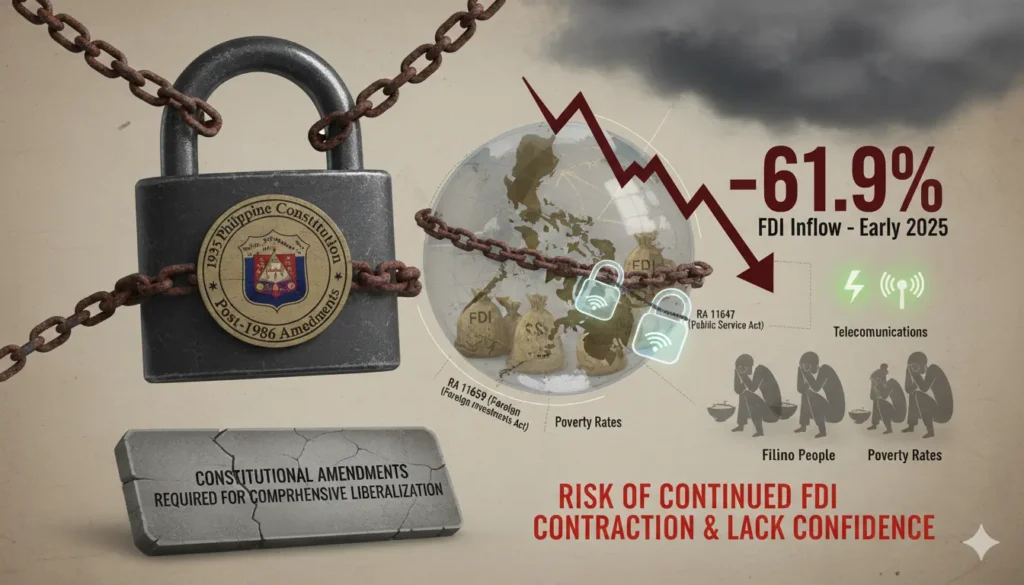
These provisions, rooted in the 1935 Constitution and reinforced post-1986 to prevent foreign dominance, have resulted in the Philippines having one of Asia’s highest FDI restrictiveness indices and poverty rates. While recent legislation like Republic Act No. 11659 (amending the Public Service Act) and Republic Act No. 11647 (amending the Foreign Investments Act) has eased some restrictions, allowing 100% foreign ownership in renewables, telecommunications, and small enterprises, constitutional amendments are required for comprehensive liberalization.
Without revisions, the Philippines risks continued FDI contraction, as evidenced by a 61.9% drop in inflows in early 2025 amid a general lack of confidence in the country.
Reversing the FDI Dearth
To address these barriers, proposals focus on amending Article XII by adding the phrase “unless otherwise provided by law” to Sections 10 and 11, delegating authority to Congress for flexible ownership limits. Resolution of Both Houses No. 7 (RBH 7), approved by the House in 2024, targets restrictions in public utilities, education, and advertising, aiming to attract FDI in infrastructure and skills development. Outright removal of the 60-40 rule for land, natural resources, and mass media has also been advocated, as these sectors remain underutilized, resulting in idle lands and limited competition.
These revisions align with recent reforms, such as the Foreign Investments Act Amendatory Law, which reduced minimum capital for foreign firms to $100,000 if they employ 15 locals or introduce technology. The creation of the Inter-Agency Investment Promotion Coordination Committee (IIPCC) under these laws promotes strategic FDI marketing. Economists argue that such changes could boost FDI by 20-30%, mirroring gains in Vietnam after liberalization. However, implementation must guard against political amendments, as past efforts under Presidents Estrada and Arroyo intertwined economic reforms with term extensions.
LGU Corruption

Corruption at the LGU level represents the most significant non-constitutional hindrance to FDI, manifesting in bribery, favoritism, and inefficient permitting processes that inflate costs by up to 20%. The 2025 U.S. Investment Climate Statement notes that LGUs’ control over local regulations, customs, and land use creates opportunities for graft, with most of respondents in surveys viewing LGU officials as corrupt.
The recent corruption scandal involving 545 billion PHP (nearly 1 billion USD) in misallocated flood control funds, which led to the 61.9% FDI drop, highlighted how LGU-engineered “ghost projects” muddy the waters. Econometric studies confirm a negative correlation between corruption, measured by the Corruption Perceptions Index, and FDI inflows, with each point improvement potentially increasing FDI by 5-10%.
A source of public shame, extant foreign investors – per the Management Association of the Philippines – increasingly factor corruption into costs, deterring entry despite liberalization efforts.
Regional Bosses
The national government’s reluctance to address LGU corruption stems from political patronage networks dominated by regional chieftains, exemplified by former President Gloria Macapagal-Arroyo’s enduring influence in Pampanga. Arroyo, who served as president from 2001-2010, faced multiple corruption scandals, including the 2007 NBN-ZTE deal and fertilizer fund scam, which diverted billions for political gain.
Despite her arrest in 2011 during the Noynoy Aquino administration for electoral fraud and plunder – later dismissed in 2016 under Duterte – she retained control over Pampanga’s 2nd district as a congresswoman, leveraging family ties and alliances to influence local governance.
Her administration’s corruption, estimated at 7.3 billion PHP in 2008 losses (approx. 200 million USD today), perpetuated a system where LGUs prioritize kickbacks over efficient FDI facilitation. Malacañang’s unwillingness to prosecute such figures due to coalition politics allows dynasties to thrive, as seen in Pampanga’s infrastructure delays, POGO legacy, Scam Center reputation and bribery demands that repel investors.
Malacañang Can Mitigate Corruption
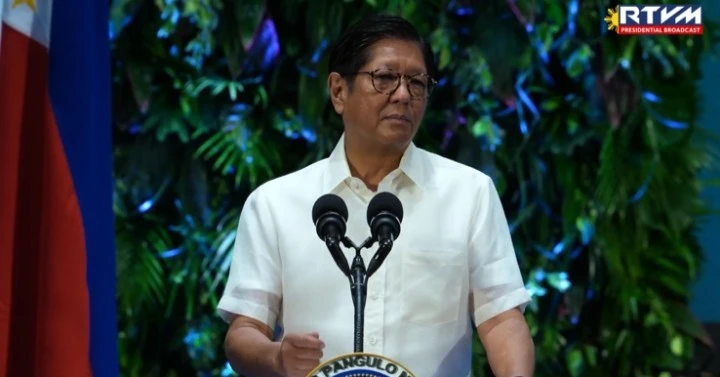
To counteract these issues, the Palace must implement robust measures:
- Strengthen Anti-Corruption Institutions: Establish an independent anti-corruption commission with prosecutorial powers, as proposed post-2025 scandal, to investigate LGU graft without political interference. Enforce Republic Act No. 3019 (Anti-Graft Act) and No. 6713 (Code of Conduct) through mandatory audits and blacklisting of corrupt contractors.
- Digitalization and Procurement Reforms: Adopt the New Government Procurement Act to digitize bidding, thereby alleviating physical bagmen, reducing LGU discretion and enabling real-time monitoring. Implement the Integrated Financial Management Information System to track funds and prevent “ghost projects.”
- Decentralized Oversight with Central Accountability: Empower the Department of Interior and Local Government (DILG) to oversee LGU compliance, while partnering with civil society for transparency initiatives like Bantay Korapsyon.
- Target Political Dynasties: Enact anti-dynasty legislation to limit family dominance, reducing patronage networks like those in Pampanga. President Marcos Jr. should lead by vetoing budgets linked to corrupt insertions, as done in 2025.
- Investor Safeguards: Integrate FDI promotion with anti-corruption clauses in agreements, offering incentives for compliance and fast-tracking disputes through specialized courts.
These steps, if pursued, would enhance FDI by fostering a transparent environment and save the economy.
A compelling argument that puts foreign direct investment at the center of the Philippines’ economic future. The article does a great job of connecting investment flows to job creation, productivity, infrastructure, and long-term competitiveness. Whether one agrees with every conclusion or not, it raises an important question: can the Philippines achieve sustained growth without attracting significantly more capital from abroad? A timely and thought-provoking read for anyone interested in economic policy and national development.