
They said WHAT???
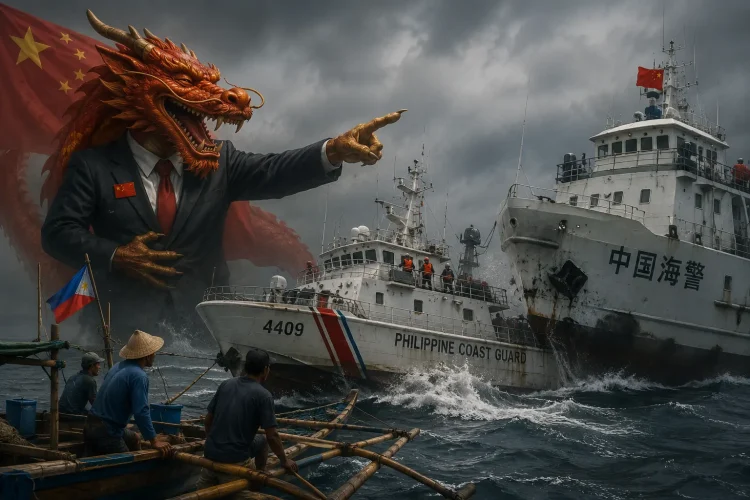
In the sunbaked waters of the West Philippine Sea, where Filipino fisherfolk chase dwindling catches and Philippine Coast Guard vessels play a high-stakes game of maritime tag with PLAN “monster ships”, a curious pattern has emerged.
Every time Chinese vessels conduct maneuvers that would make even the most seasoned sailor mutter “not again,” the Chinese Embassy in Manila and its overlords in Beijing issue a statement so petulant, so dripping with juvenile outrage, that one wonders if the drafters are moonlighting as writers for the Babylon Bee.
It’s not diplomacy. It’s performance art. And the target audience? Philippine Defense Secretary Gilberto “Gibo” Teodoro, whose head, according to keen observers in Malacañang’s war rooms, spins with the rotational velocity of a malfunctioning centrifuge each time the B.S. begins to flow out of Ambassador Jing Quan’s pouty little mouth.
Gray-Zone Harassment, Followed by Kindergarten Clapback
Picture the scene: A flotilla of PLAN and China Coast Guard vessels executes another “routine patrol” that just happens to involve water cannons, dangerous blocking maneuvers, anchor-line slicing, or the occasional floating barrier across traditional fishing grounds. Filipino boats get harassed. Reefs and outposts like Ayungin or Scarborough are trashed. Fishermen come home with tales of intimidation and damaged gear.
In response, Gibo shoves his fist and arm down Chinese throats, up to the shoulder. Now, cue the embassy statement. Instead of the measured language one might expect from a superpower, we get gems accusing Manila of “slander,” “irresponsible remarks that incite hatred,” “provocations,” and the classic, “staging incidents for political gain”. Recent highlights include warnings that bad relations could cost “millions of jobs” and sanctions on Teodoro himself (including his family, for good measure) after he dared call things as he sees them.
To the untrained eye, this reads like genuine diplomatic fury. To those fluent in the ancient art of Taking the Piss (as our British friends so elegantly phrase it), it’s something far more sophisticated: psychological entertainment for the boys back in Beijing. A low-cost, highly amusing way to watch Gibo – known for his unflinching, strong-worded rebuttals labeling Chinese claims as “fiction and lies” – go into full rhetorical overdrive. Think the mainstream US media poking at Trump to garner blabbering “orange-man-bad” retorts that they can sell to advertisers.
“It’s like they’ve got a dedicated team whose KPI (Key Performance Indicator) is ‘make the Filipino defense chief’s blood pressure hit new records,’” quipped one Manila-based ambassador, speaking on condition of anonymity because even diplomats need to eat. “The statements have all the maturity of a playground taunt: ‘No, you’re the bad boy! – Nanny-Nanny-Boo-Boo!!’, when meanwhile, the actual ships keep doing what they do.”
Childish Vitriol as Strategy
Analysts (the ones not on any embassy payroll) suggest this isn’t accidental. The tone – equal parts condescending and whiny – serves multiple purposes:
- Domestic signaling: Look tough for the home crowd and China-supporting/paid Filipino journalists.
- Narrative control: Flip the victim script so thoroughly that Filipino fishermen become the aggressors for, gasp, trying to fish where their ancestors fished.
- Pure troll value: Why waste expensive missiles when a well-crafted press release can achieve the same headache-inducing effect on Manila’s leadership?
It’s gray-zone warfare meets dad-joke diplomacy. While real hazards mount for fisherfolk in the forms of injuries, damaged vessels, and poisoned reefs from alleged sabotage, Beijing’s wordsmiths pen paragraphs that read like they were composed after one too many baijiu sessions.
Teodoro, for his part, refuses to play the straight man. His responses are the verbal equivalent of grabbing the microphone and dropping the beat: firm, factual, and occasionally laced with the kind of fire that makes Chinese spokespeople reach for the smelling salts. The cycle repeats: Incident → Gibo Rages → Embassy Statement → Repeat. Ratings, gold – if this were a reality show.
The Human Cost Behind the Meme
Of course, humor has limits. For the men and women braving those waters daily – the fisherfolk whose livelihoods depend on waters Beijing claims as its own private pond – this isn’t entertainment, it’s survival. Philippine vessels conducting resupply or escort missions face real risks, and the diplomatic theater does little to ease the pressure on the ground (or sea).
Yet one can’t help but admire the sheer audacity. In an era of high-tech weaponry and satellite surveillance, the Chinese Communist Party has weaponized the group chat energy of a drunk uncle on Facebook. “How dare you defend your own waters!” the statements effectively cry, while their ships demonstrate exactly why such defense is necessary.
Will the Show Go On?
As tensions simmer into 2026, with more joint patrols conducted by the US, Japan, EU and Australia with the Philippines, probes into new structures on disputed features and the usual cycle of accusations, expect the embassy’s output to remain as reliably spicy as adobo on a hot day.
Whether it’s masterful strategy or just the world’s most expensive comedy routine remains debatable. But if the goal is to keep Manila perpetually annoyed while Beijing’s vessels hold the line, it is mission accomplished, with a side of existential eye-rolling from external observers.
In the meantime, Filipino officials might consider a new tactic: responding with nothing but polite, Canadian-style acknowledgments, such as “Great job, boys, eh?!” or “care for a Molson, ole buddy?!” One suspects that would really make a few rotten dumplings burst in the Forbidden City.
A sharp and timely piece that calls out the hypocrisy behind China’s diplomatic outrage while its actions in the West Philippine Sea tell a very different story. By framing Beijing’s rhetoric as “taking the piss,” the article highlights the growing disconnect between words and behavior, reminding readers that sovereignty, maritime rights, and national dignity are not defended through statements alone. An insightful read on the strategic narratives shaping one of Southeast Asia’s most important geopolitical flashpoints.
Grab a Molsen, eh?! Excellent!