
Countries Most Affected
A total pullout would primarily affect traditional treaty allies and close partners like the Philippines (Mutual Defense Treaty, EDCA sites), Thailand (Major Non-NATO Ally, Cobra Gold exercises), Singapore (logistical hub, access agreements), and emerging partners like Vietnam (Comprehensive Strategic Partnership – CSP).
Other members (Indonesia, Malaysia, Brunei, etc.) would feel indirect effects through regional dynamics. ASEAN’s diversity, ranging from pro-U.S. balancers to China-leaning states, would lead to fragmented responses rather than unified action.
Short-Term Shock (Months 1–18)
- Philippines: Hit hardest as a frontline state. Loss of EDCA access (nine sites for training, prepositioning, and operations), joint exercises (Balikatan), Marine rotations, and U.S. arms/financing would weaken deterrence in the South China/West Philippine Seas. China would escalate former gray-zone tactics – water cannon incidents, blockades at Scarborough Shoal or Second Thomas Shoal, militia swarming – to full on attacks and seizures without fear of U.S. intervention. Manila would face domestic pressure to concede or seek urgent alternatives like Japan, Australia, and South Korea. Economic fallout from disrupted trade routes and fishing would compound this.
- Vietnam: A key South China Sea claimant, it relies less on U.S. aid and values diversification from Russian equipment. Without U.S. security cooperation, coast guard support, or potential F-16 deals, Hanoi would accelerate hedging. Deeper ties with Japan/India (i.e., BrahMos missiles), Quad+ engagement, or reluctant bilateral deals with China would avoid escalation. It might increase patrols but risk more incidents with the PLA on land and PLAN on the seas.
- Singapore, Thailand, and others: Singapore’s logistical role (P-8s, ship support) diminishes, prompting it to bolster its own advanced capabilities (F-35s, submarines) and diversify partnerships. Thailand’s Cobra Gold exercises end. As a traditional U.S. partner, it might tilt further toward China economically/militarily while struggling to maintain autonomy. Indonesia and Malaysia, already hedging, would emphasize “ASEAN centrality” and non-alignment but face intensified Chinese pressure on EEZs and resources. Brunei (small but claimant) has limited options.
- Regional dynamics: China fills the vacuum rapidly via its navy, coast guard, and maritime militia. Expect more island-building/reclamation, broadening ADIZ exclusions, and arbitrary restrictions on navigation/fishing. Freedom of navigation operations cease, shifting de facto control to Beijing. ASEAN unity fractures further on South China Sea issues, with pro-China states (Cambodia, Laos) blocking strong statements and diplomatic protests.
Wider effects include higher insurance/shipping costs, potential oil/gas exploration halts, and refugee/migration pressures from instability.
Medium Term (2–5 Years)
Military modernization and diversification: ASEAN states ramp up indigenous or alternative sourcing. Philippines/Vietnam/Indonesia pursue submarines (from Japan, South Korea, India, Europe), and coast guard fleets. Singapore leads in high-tech (drones, cyber). This creates mini-arms races but interoperability challenges without U.S. standards and guidance.
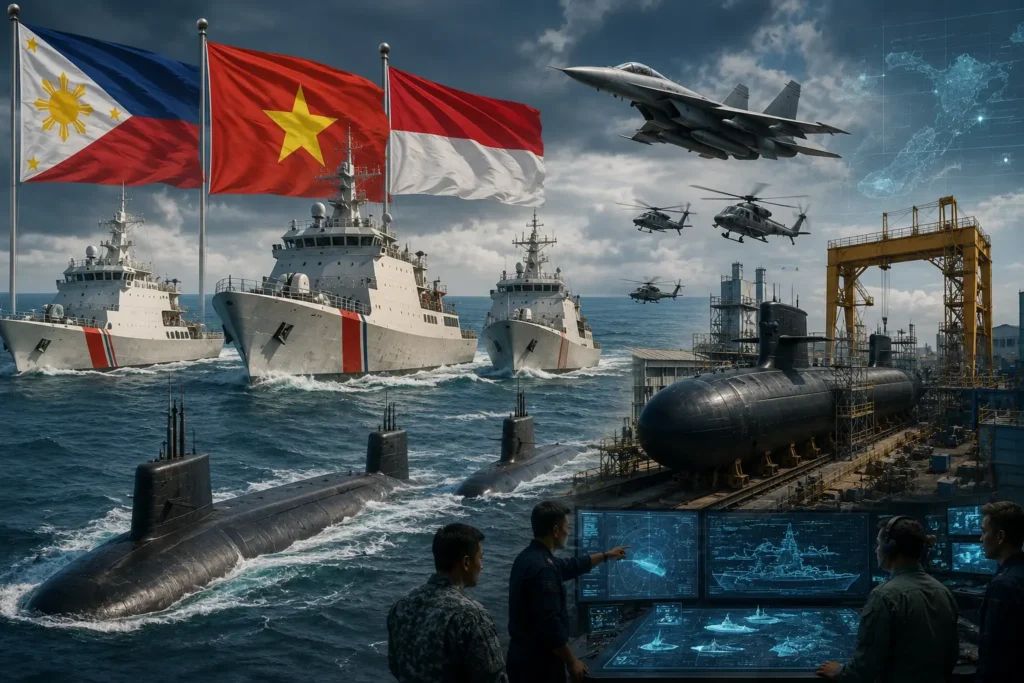
- China’s dominance in the South China Sea: Beijing would achieve effective control over much of the area, enforcing a “community of shared future” narrative. Bilateral deals sideline multilateral efforts like a Code of Conduct. Economic leverage (Belt and Road, trade dependence) pulls neutral states closer, isolating hardliners like the Philippines.
- Intra-ASEAN and external balancing: ASEAN strengthens internal mechanisms (ADMM-Plus) but struggles with consensus. Mini-lateral groupings emerge: Philippines-Vietnam-Japan-Australia cooperation on maritime domain awareness. Extra-regional players (Japan, Australia, India, EU) increase engagement to counter China, but without U.S. scale, it’s patchwork. Some states, like Cambodia and Laos, deepen China ties for infrastructure/security.
- Economic/security nexus: Trade disruptions and Chinese investment fill gaps, but at the cost of sovereignty concessions (port access, resource deals). Tourism and energy sectors suffer volatility.
Long-Term (5+ Years)
- Chinese sphere of influence: Much of maritime Southeast Asia operates under de facto Chinese parameters for navigation and resources, with ASEAN as a weak, nominal forum. Cambodia, Laos, and Myanmar align more closely with Beijing.
- Fragmented multipolarity: A core group (Philippines, Vietnam, Singapore, Indonesia) forms a loose maritime security network with Japan/Australia. Neutral hedging becomes the norm, but smaller members face “choose sides” pressure. Risks include localized clashes escalating or proliferation if deterrence erodes.
- ASEAN resilience/limits: The bloc doubles down on “centrality” and economic integration, such as RCEP (Regional Comprehensive Economic Partnership) strengthening to maintain relevance, but security remains its Achilles’ heel without a strong external balancer. Overall regional autonomy decreases as Chinese dominance intensifies.
U.S. Perspective
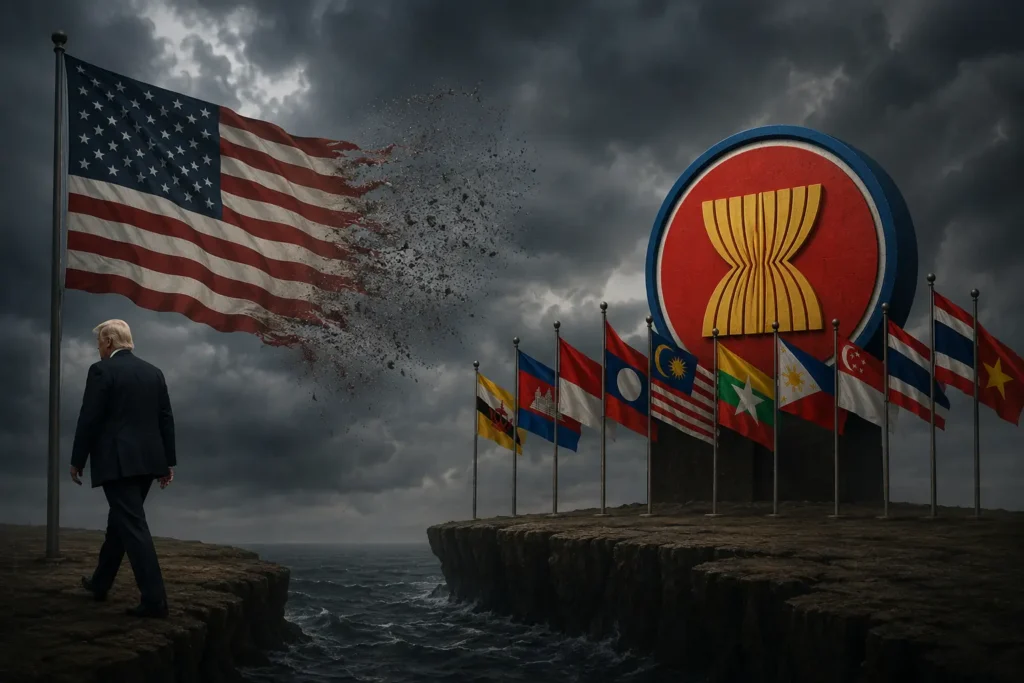
Denying support to ASEAN would mean short term savings on deployments but much more costly lost influence, disrupted sea lanes (critical for global trade), and potential refugee/terrorism spillovers. Allies would resent abandonment, accelerating global perceptions of U.S. unreliability.
This scenario assumes no major war erupts immediately (China prefers “salami-slicing” below conflict thresholds), but miscalculations could change that. Outcomes hinge on Chinese restraint, ASEAN cohesion, and third-party involvement. Real-world partial U.S. shifts already show hedging trends; a full withdrawal would accelerate them sharply.
In short, regardless how much the CCP pays regional elite “AUSOPs” (Anti-US-One-Percenters) to act as cheerleaders for Beijing over Washington, the outcome of an American exit is so unthinkable that continuing with such a strategy is of zero practical use. Wasting money is something the Chinese know very well but, in this case, they are in fact paying for their own bad press.