
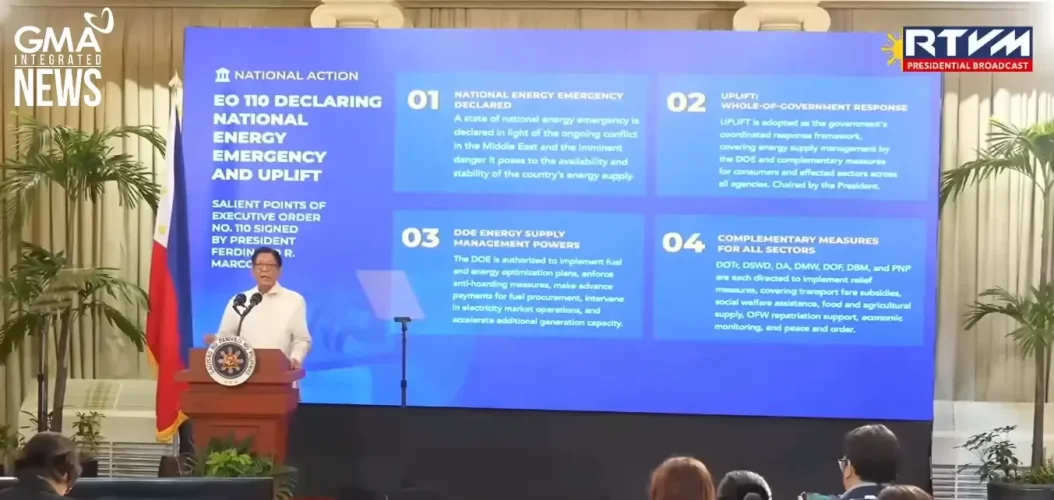
Addicted to Middle East Oil
The Philippines imports approximately 170 million barrels of crude oil and petroleum products annually, with 98% of crude and 97% of refined products tracing back to Middle Eastern sources via Asian refineries. The Malampaya gas field, which once supplied 40% of Luzon’s power, is projected to deplete by 2027, forcing a surge in costly LNG imports projected to rise 508% from 2025 to 2029.
Against this backdrop, the Hormuz crisis has produced a textbook energy shock: oil prices surged over 5% in a single session, freight and insurance costs skyrocketed, and Manila declared a national energy emergency. In a Bloomberg interview on 24 March, President Marcos explicitly linked the Middle East turmoil to renewed SCS talks, stating that “territorial disputes… get in the way” but that the crisis “may provide the impetus for both sides to come to an agreement.”

This reaction echoes earlier Philippine attempts at joint development – the 2005 Joint Marine Seismic Undertaking (JMSU) with China and Vietnam, which collapsed amid domestic corruption scandals and sovereignty concerns. Yet the structural asymmetry between a rising superpower and a smaller claimant state, combined with Beijing’s refusal to acknowledge the 2016 arbitral award, renders any new agreement fraught with peril.
Geopolitical Asymmetry
The Philippines’ exclusive economic zone (EEZ) encompasses Reed (Recto) Bank, an area the 2016 Permanent Court of Arbitration ruling classified as unambiguously within Philippine jurisdiction and outside any Chinese “nine-dash line” entitlement. Chinese estimates place undiscovered resources in areas they claim at 125 billion barrels of oil and 500 trillion cubic feet of gas – figures U.S. analysts regard as inflated but nonetheless drive Beijing’s interest.
Marcos’ 2023 state visit to Beijing produced a memorandum to resume discussions yet talks stalled over constitutional requirements that the state retain “full control and supervision” of natural resources (1987 Philippine Constitution, Art. XII, Sec. 2). The current Hormuz-induced emergency appears to have lowered Manila’s threshold for compromise.
Short-Term Pitfalls
- Legal and Constitutional Quagmires– Any service contract must conform to Philippine law; foreign partners can only act as subcontractors. Beijing has historically rejected this framing, viewing it as an implicit acceptance of Philippine sovereignty. A rushed deal risks Supreme Court challenges or impeachment proceedings, as occurred after the JMSU.
- Alliance Costs and U.S. Repercussions– The U.S./Philippine Mutual Defense Treaty (MDA 1951) and the 2014 Enhanced Defense Cooperation Agreement (EDCA 2014) tie Manila’s security to Washington. Joint development in an area Beijing claims would complicate U.S. freedom-of-navigation operations and could trigger congressional scrutiny of security assistance. Domestic political backlash, already evident in protests over Chinese coast-guard actions, would intensify, depleting BBM’s legitimacy.
- Unequal Economic Bargaining– China National Offshore Oil Corporation (CNOOC), a state-owned enterprise, would dominate negotiations. Historical precedents (i.e., JMSU) show Beijing extracting disproportionate shares while Philippine firms bear exploration risks. Immediate LNG-import substitution via domestic gas would be delayed by protracted talks, exposing households to 11–24% higher electricity costs in the interim.
Long-Term Downsides
- Sovereignty Erosion and “Salami Slicing”– Joint development agreements often serve Beijing as legal cover for incremental control. Crisis Group analyses document how China uses civilian presence to normalize militarized facts on the ground. Once infrastructure is co-located, withdrawal becomes politically and economically costly, classic “debt-trap” dynamics observed in other BRI energy projects.
- Economic Dependency and Opportunity Costs –IMF projections warn that sustained fossil-fuel import dependence could reach 61% of primary energy supply by 2050, worsening balance-of-payments volatility. A China-centric deal would divert capital from renewables (the DOE’s 35% RE target by 2030) and lock in higher long-run costs once Malampaya is exhausted. Environmental liabilities (methane leaks, coral damage) would compound climate-adaptation expenses already projected at billions.
- Geopolitical Isolation and Regional Spillovers– ASEAN unity on SCS/WPS issues would fracture; Vietnam and Malaysia, pursuing their own unilateral or multilateral options, would view Manila’s bilateralism as precedent-setting weakness. Heightened Chinese naval presence around Reed Bank could provoke incidents, raise insurance premiums and deter third-party investors.
- Security Dilemmas– The 2016 award’s non-implementation would further delegitimize international law, encouraging gray-zone tactics elsewhere. Philippine Coast Guard and Navy modernization, already strained, would face renewed Chinese harassment, as documented in Reed Bank incidents since 2011.
Policy Alternatives
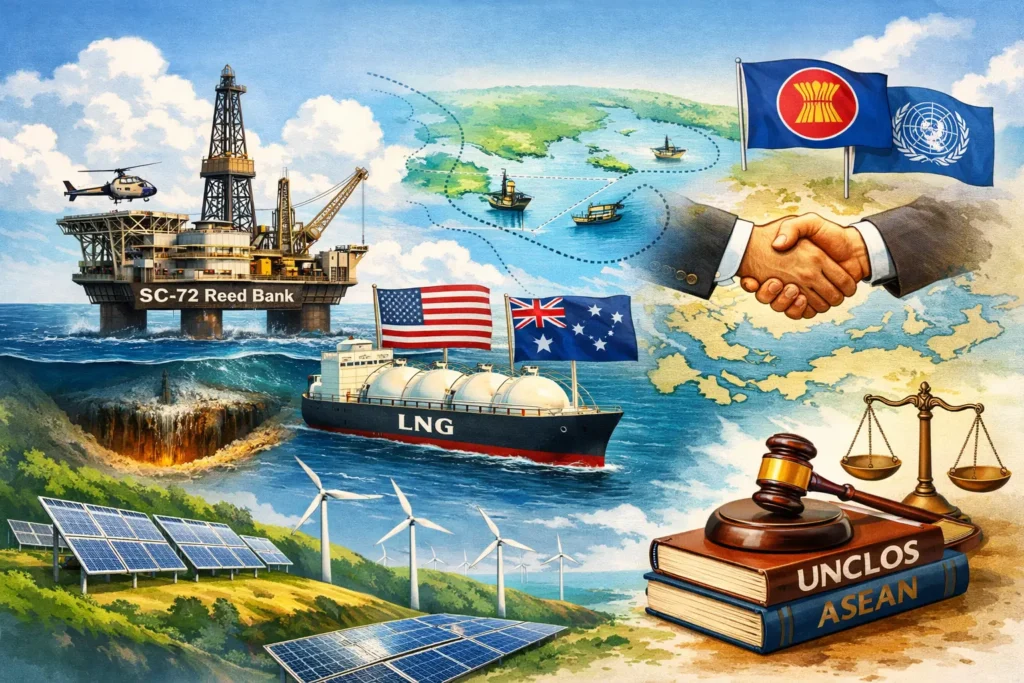
A more prudent strategy would be to accelerate domestic exploration under Philippine service contracts, such as SC-72 at Reed Bank, diversify LNG sources from the U.S. and Australia, and fast-track renewables. Multilateral frameworks – ASEAN-led or UNCLOS-compliant joint development zones – offer legal safeguards absent in bilateral deals.
The Hormuz crisis is real; the temptation to grasp at Chinese partnership is understandable. Yet the political and economic literature on asymmetric joint development in disputed waters consistently demonstrates that short-term relief masks long-term entrapment. For the Philippines, the true energy security imperative is not a hasty pact with Beijing but disciplined adherence to the 2016 arbitral award, diversified supply chains, and accelerated decarbonization. Anything less risks trading one form of import dependence for a far more corrosive form of strategic subordination.
References and Cites Available Upon Request