
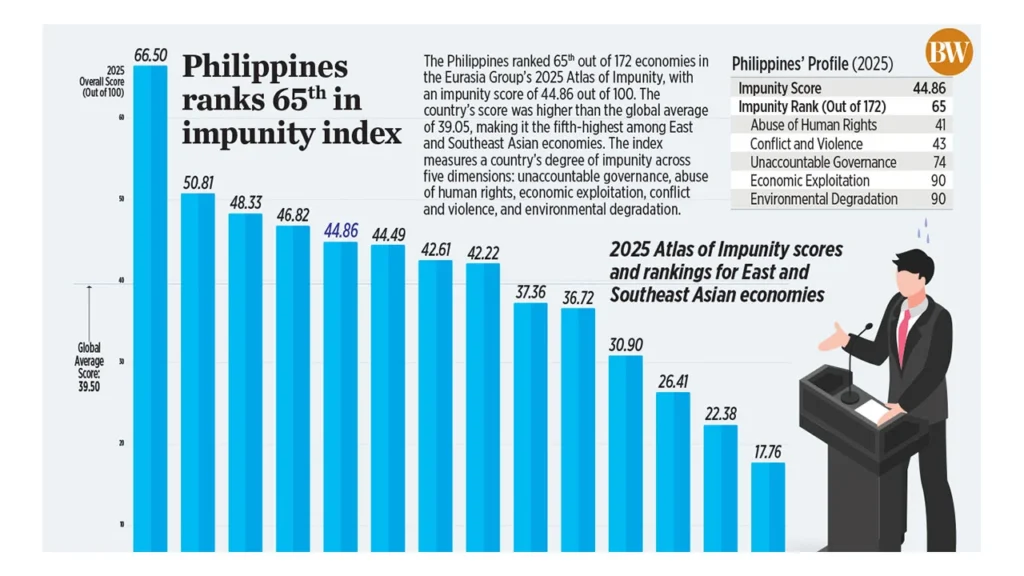
MANILA — A recent Philippine Inquirer article authored by Kurt Dela Peña has left both reformers and professional rule-breakers equally puzzled. His piece states the Philippines officially ranked 65th out of 172 countries in the 2026 Atlas of Impunity, posting a score of 44.86. Higher numbers mean more impunity, and local officials were quick to celebrate the result as proof that the country remains competitive in the regional “WSL” (Wala Silang Pakialam) league.
The index, produced by the Eurasia Group and Thomson Reuters Foundation, measures the noble art of exercising power without consequences across five categories: (1) unaccountable governance, (2) economic exploitation, (3) environmental degradation, (4) conflict and violence, and (5) abuse of human rights. The Philippines performed notably in the human-rights and conflict categories (41st and 43rd globally), confirming long-standing suspicions that the national talent for selective accountability remains strong.
Beat the Professionals, Lost to the Killjoys
In Southeast Asia the rankings produced the usual mix of pride and quiet envy. The Philippines finished ahead of Cambodia (33rd) and Laos (57th), two countries widely regarded as the heavyweight champions of institutional shrug. Indonesia, ever the near-twin, came in right behind at 66th with a slightly less impressive 44.49.
Unfortunately, the nation trailed the usual suspects who keep insisting on functioning institutions: Vietnam (77th), Thailand (81st), Malaysia (110th), and the eternal spoilsport Singapore (139th, score 26.41). Analysts noted that Singapore’s poor showing was predictable. When a country treats chewing gum as a national security threat, the concept of “getting away with it” never really takes root.
One data scientist observed that the gap with better-performing ASEAN neighbors is most visible in unaccountable governance. The Philippines ranked a respectable 74th there (score 52.60), which is still worse than the global average but better than countries that have fully embraced authoritarianism. “Democracy alone does not guarantee accountability,” the expert said, in what may be the most politely devastating sentence of the year.
We Are Not Last, and That Counts
Government spokespeople expressed cautious optimism. “Sixty-fifth is not first, but it is also not 172nd,” one official noted. “We remain firmly in the middle of the pack, which is the Filipino way: neither the worst nor the most boring.” Another source close to the ranking process suggested that with a little more effort in environmental degradation and economic exploitation – currently tied at a disappointing 90th – the country could climb into the top 50 by the next edition.
Critics, of course, saw the glass as half-empty and slightly cracked. “We have one of the longest-running electoral democracies in the region,” one observer muttered, “and somehow still manage to look at Singapore’s score and feel personal offense.” Others pointed out that performing better than countries currently hosting active civil wars might not be considered a major policy achievement.
Why Sweat the Ranking?
The Atlas of Impunity ultimately suggests that elections every few years are nice, but institutions that actually restrain power are nicer. Until then, the Philippines can take comfort in its consistent mid-table performance: good enough to avoid total collapse, bad enough to keep the late-night talk shows supplied with material, and just competitive enough to remain slightly ahead of the wild-eyed Indonesians in the regional standings.
In related news, several local officials were seen practicing their “no comment” faces in preparation for the next index interviews. Early reports indicate their training is going extremely well.