
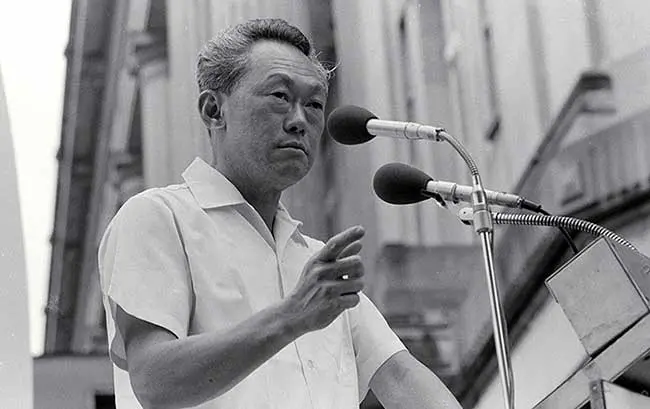
 Lee Kuan Yew became Prime Minister of Singapore in June 1959, after the PAP (People’s Action Party) won election under the new self-government and retained that position until 1990. The systematic dismantling of the old “Dai-Lap” class – the wealthy, mostly Chinese-educated Towkays (Hokkienese for “business owner, boss, or master”), land-owning tycoons, secret-society-linked businessmen, and colonial-era Compradors (influential middlemen) who previously acted with almost complete impunity – happened mainly between the date of independence from Malaysia and the mid-1970s.
Below are the concrete, disruptive moves he made to strip them of political power and lack of accountability:
| No. | Measure | Year(s) | How it destroyed elite impunity |
| 1 | Created the Corrupt Practices Investigation Bureau (CPIB) and made it independent | 1959 onward | CPIB could investigate anyone, including ministers and tycoons, without court permission. The early prosecution of Tan Kia Gan (1960) shocked the old elite. |
| 2 | Land Acquisition Act (revised and aggressively used) | 1966 onward | Government could compulsorily acquire private land at sub-market rates, destroying land-based elite power. |
| 3 | Destruction of secret societies and triads | 1960s–1970s | Triads and clan-linked secret societies were dismantled through preventive detention and sustained police action. |
| 4 | Takeover and depoliticization of trade unions | 1961–1968 | Operation Coldstore and labor laws removed tycoon-linked unions as political instruments. |
| 5 | Central Provident Fund (CPF) and HDB housing monopoly | 1960–1980s | Public housing and forced savings dismantled slum-lord and rental empires. |
| 6 | Banking & tax transparency; IRAS enforcement | 1960s–1970s | Cash-based tycoon empires collapsed under compulsory disclosure and tax enforcement. |
| 7 | Meritocratic civil service & statutory boards | 1959 onward | Professional technocrats replaced old-money patronage networks. |
| 8 | Newspaper and Printing Presses Act | 1974–1986 | Media ownership was neutralized as a political weapon through state management shares. |
| 9 | Ruthless use of defamation laws | 1970s–1990s | Wealth and status offered no protection from defamation suits when challenging power. |
| 10 | Co-optation of compliant businessmen | 1960s onward | Tycoons prospered only as state-aligned national champions, not independent forces. |
The Key to it All: Making the Police and Armed Forces Incorruptible
Arguably the pivotal measure implemented by LKY as soon as he came into office was to increase the salaries of the police and military to an extent where they would no longer be attracted to bribes or patronage from the elites.
This single act, effectuated during the first weeks of the new government’s existence, immediately alleviated the ability of the towkays and dai-laps to engage in illegal activities (even so much as allowing their drivers to speed or double park), flex influence within government departments, or land grab / bank to the detriment of Singaporean citizens. The remaining government workforce was elevated during the ensuing months, guaranteeing that only the best and brightest would occupy official positions, those who, for the first time, could proudly say “no!” to the elites.
Results by the late 1970s
The old-style dai-lap who could bribe officials, use gangs, control unions, sit on huge land banks, or buy political parties simply ceased to exist as a socio-political class. Wealth was still possible – even encouraged – but only if it was earned within a rigid framework of rule of law that applied to everyone, including the richest. That is the fundamental difference between Singapore and the Philippines today.
Lee Kuan Yew did not just pass laws; he deliberately and systematically broke the economic, criminal, and political instruments that had previously given the old elites impunity. Only in this way can the Philippines throw off the onerous, sticky mantle of corruption and impunity that oppresses its people. Filipinos! Create your Lee Kwan Yew!