
How big is it?
Market estimates vary by definition (topicals only versus a broader “tone management” category that includes serums, soaps, supplements, and clinic procedures), but they point to a multi-billion- US Dollar regional business that is still growing. One 2024–2026 estimate put Southeast Asian skin-lightening consumer products alone at about USD 1.67 billion in 2024, rising to USD 3.61 billion by 2034. Global skin-lightener sales are on the order of USD 10–12 billion, with Asia-Pacific the largest bloc.
The best systematic surveys (university students, mid-2020s) show high use:
- Across five ASEAN countries, 38.7% of students used a lightening product in the previous 12 months (3/4 of that figure are women).
- Range in that study: 13.4% in Myanmar to 69.4% in Thailand.
- An overlapping 26-country study found 83.8% past-year use among Thai students, the sample’s highest figure.
- Smaller studies have reported over half of Filipino women and about 60% of Malaysian respondents as users. Male use is lower but common (often 15–25% in student samples).
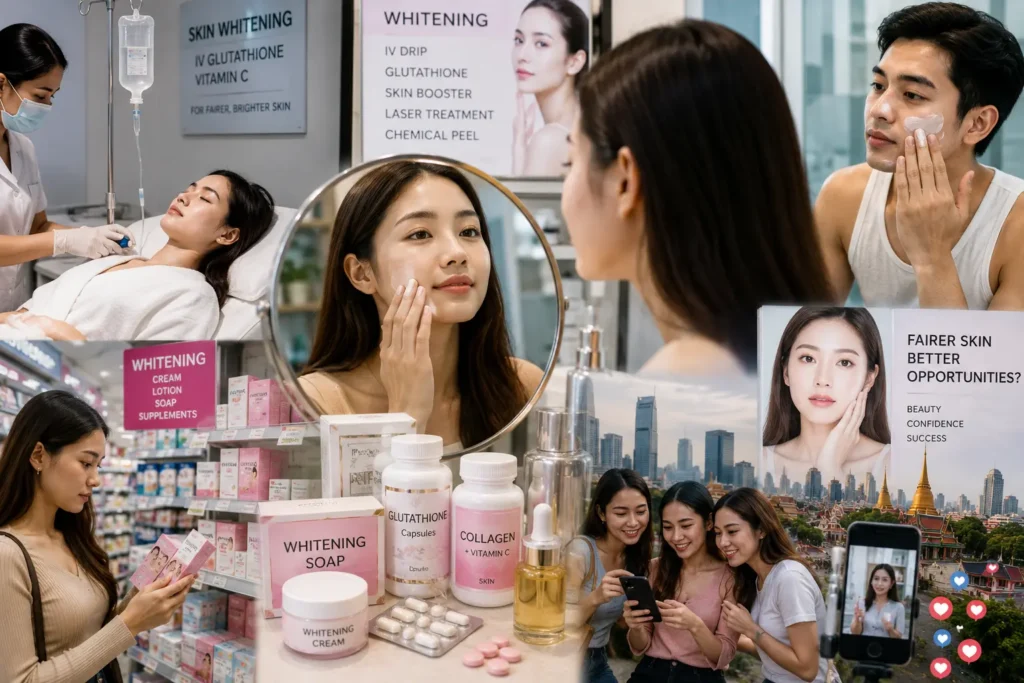
Those data are recent and drawn from educated urban youth. Clinical demand is harder to measure but highly visible. Glutathione (a tripeptide that is produced naturally in the body) I.V. drips are a staple in clinics in Metro Manila, Kuala Lumpur, Bangkok, and growing in Vietnam, typically USD 50–300 per session and sold in packages. Manila regulators and the Philippine Dermatological Society say injectable glutathione is not approved for skin-lightening, evidence of efficacy is weak, and risks include liver / kidney injury, Stevens-Johnson syndrome, and infection. It is completely banned in most Western countries.
ASEAN rules ban mercury and restrict hydroquinone or certain steroids in cosmetics, but effective enforcement is lacking. Often imported from South Asia and sold online or informally, Mercury-laced creams with dosages of thousands of times the 1 ppm limit still appear in Philippine FDA alerts. Brands have reacted to the negative press: “whitening” and “bleaching” now give way to “brightening,” “glow,” “even tone,” and “healthy radiance,” while the motive remains a lighter or more uniform complexion.
Cultural Motivations
Despite assertions from sociologists and historical revisionists, preference for lighter skin in the region predates European colonialism, yet no one disputes the effect that the desire for increased societal status – exacerbated by modern media – has also had a significant psychological effect over the past 40 years.
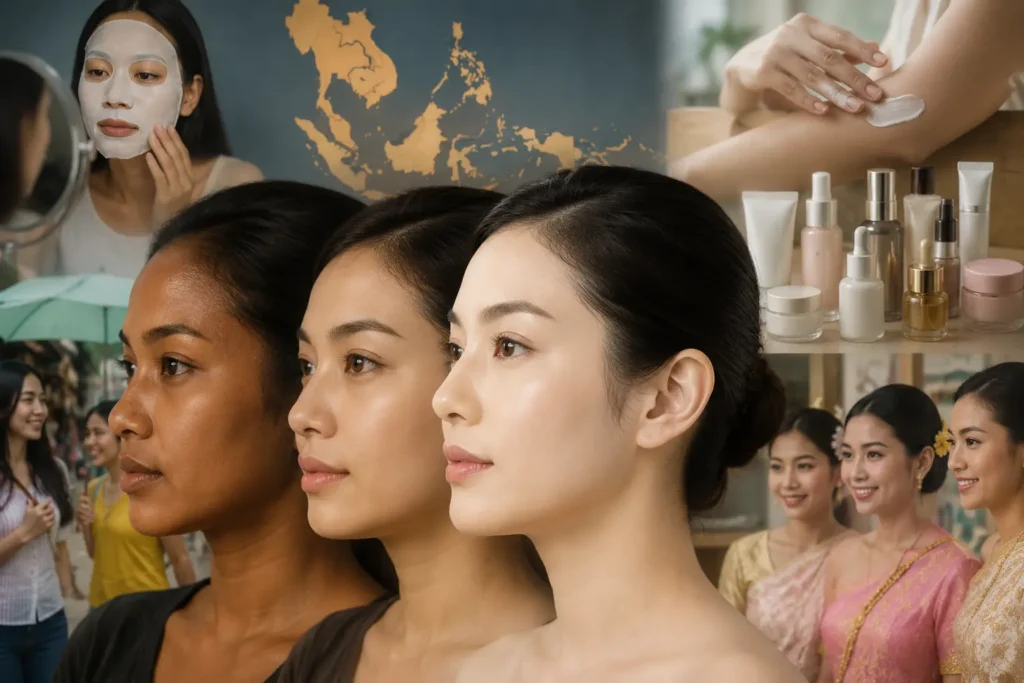
In pre-colonial and early-modern Southeast Asia, darker skin marked outdoor agricultural labor; paler skin signaled elite indoor life. Thai classical literature praised heroines with complexions “as if painted with gold.” Similar associations appear in Javanese and other Indonesian sources. That class reading never vanished. It is why umbrellas, long sleeves, and high-SPF products are everyday urban behavior in Bangkok or Manila, even when the stated goal is “health.”
Colonial hierarchies hardened the preference. Spanish casta ranks in the Philippines made mestizo features and lighter skin a durable status marker. Dutch rule in the Indies put Europeans on top, Chinese in the middle, and “native” Indonesians at the bottom. British Malaya and French Indochina produced analogous rankings. These systems did not invent color preference, but they were nonetheless tied to power, education, and marriage advantage. Post-independence elites often reproduced the same visual hierarchy in ads, film, and pageants.
Hollywood and those K-razy Koreans
American movie idols and local mixed-race celebrities long set the template. Since the 2000s, Korean dramas, K-pop, and K-beauty (“glass skin,” pale-pink undertones) have intensified and slightly shifted the ideal from a “heavenly pale” to a cooler, more translucent one. Thai commentators note the move from classical “gold-painted” fairness to a “pinkish white” associated with Korean stars. Unilever, L’Oréal, and regional brands still use overwhelmingly lighter-skinned models. Social media multiplies the effect with influencers hawking “compulsory brightening routines”, with the goal of feeling both attainable and necessary.
Surveys and interviews repeatedly link lighter skin to better jobs, perceived competence, and marriage-market advantage. Users often say the products raise self-esteem or make them “stand out.” Poor mental health and lower perceived self-imaging were associated with use in ASEAN student studies, suggesting both a status strategy and a coping behavior. Men’s growing use is often framed in career terms (“if you’re fair-skinned, you’re noticeable”).
Questions on Mental Health
Today, social media creates demand through subliminal shaming and algorithm manipulation. Brands and clinics follow suit with celebrity culture advertising to induce purchases. Public-health campaigns and “love your Morena (Spanish for tanned or olive skin, incorporated into Tagalog) / Kulit Sawo Matang (Bahasa Indonesia for brown skin)” messaging exist, especially in the Philippines, but they compete against a much larger commercial machine that is enhanced by family and peer comments lamenting darker skin as a problem to “fix”.
Notably, this phenomenon isn’t uniform across the region. Singapore is more tightly regulated. It regards the application of intravenous delivery of Glutathione for beauty treatments as illegal, acceptable only for peptide deficiency therapy by licensed medical doctors. Myanmar has the lowest student use in the five-country survey, where rural study cohorts buy fewer premium products than urban Gen Z. The direction of industry trending is continued expansion under softer language, so it looks as if this most questionable of personal beauty practices will exist for a very long time to come, indeed.