
Imaginary Dots and Dashes
China’s “nine-dash line” (sometimes rendered as ten dashes in recent maps) asserts historic rights over roughly 90% of the maritime region west of the Philippines, encompassing features and waters claimed or administered by several ASEAN states. A 2016 Permanent Court of Arbitration award in a case brought by Manila found no legal basis for these historic-rights claims within the line and affirmed that most Spratly features preside over no EEZ.
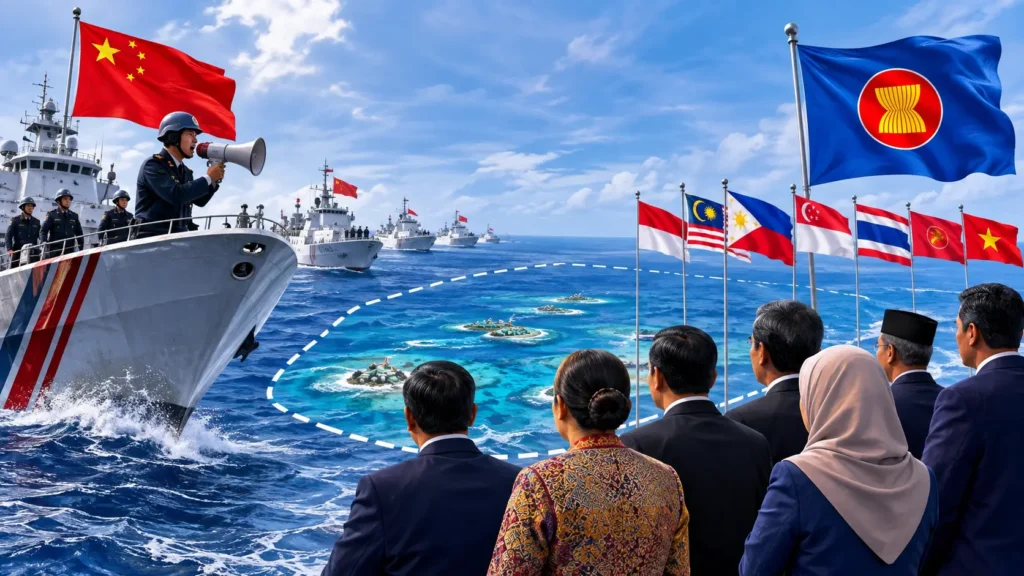
Beijing rejected the ruling and has continued island-building, militarization, and the use of the People’s Liberation Army Navy (PLAN), China Coast Guard (CCG), and maritime militia to enforce its position through harassment of fishing, surveys, and resupply missions.
Historical Pattern of Pressure
Chinese assertiveness accelerated in stages. In 1974, PLAN and militia forces seized the western Paracels from South Vietnamese units after a brief naval clash. In 1988, Chinese forces occupied several Spratly features, sinking three Vietnamese vessels at Johnson South Reef and killing dozens of sailors.
The 1990s brought the Mischief Reef occupation (challenging the Philippines). From the mid-2010s, large-scale reclamation turned reefs into air-and-naval bases, while gray zone tactics – water cannons, ramming, and swarming – became routine against Philippine, Vietnamese, Malaysian, and Indonesian vessels. ASEAN’s consensus rule has repeatedly limited collective pushback; Cambodia blocked a 2012 joint communiqué amid the Scarborough Shoal standoff.
Claimant and Directly Affected States
The Philippines has shifted from accommodation to the most public resistance. After the 2012 Scarborough loss and the 2016 award, the Duterte administration was obedient to Beijung. Under President Ferdinand Marcos Jr., Manila pivoted back toward the U.S., publicizing CCG water-cannon attacks, ramming, and blockades (especially at Second Thomas Shoal / Ayungin, where the grounded BRP Sierra Madre serves as an outpost). It has upgraded island infrastructure, resumed Scarborough patrols, deepened alliances with the West and Japan, and secured international statements supporting the arbitral award. Harassment has intensified rather than receded, but underdog Philippines has stalwartly sustained resupply missions and resource claims.

Vietnam carries the deepest historical scars (1974, 1988, and the 1979 border war). It occupies the largest number of Spratly features, has expanded artificial islands and infrastructure, and continues oil-and-gas activity near Vanguard Bank despite persistent CCG presence. Hanoi issues diplomatic protests, fields its own maritime militia, modernizes naval and coast-guard assets, and quietly coordinates with the Philippines. It rejects claims exceeding UNCLOS limits but prefers managed operational firmness over the Philippines’ high-visibility approach to avoid full economic rupture.
Malaysia practices “quiet diplomacy.” It rejects the nine-dash line’s legal basis, has filed extended continental-shelf claims, and proceeds with hydrocarbon exploration (Luconia Shoals, Kasawari, and Sarawak wells) despite regular CCG shadowing and diplomatic notes. Naval and enforcement vessels occasionally shadow Chinese patrols but rarely escalate. Kuala Lumpur prioritizes bilateral economic ties and avoids the Philippines’ transparency model.
Brunei is the “silent claimant.” Its EEZ and Louisa Reef claims overlap the Chinese line, and hydrocarbons are economically vital, yet it maintains no significant military presence in disputed waters and has not publicly rejected the nine-dash line. It favors bilateral talks, UNCLOS language in general statements, and economic cooperation (including joint-development language with Beijing). Structural dependence on Chinese investment and trade underpins the restraint; analysts describe deference driven by diversification needs rather than outright surrender of claims.
Indonesia is not a classic island claimant but faces nine-dash overlap in the North Natuna Sea EEZ. Jakarta has repeatedly stated that the line has no legal basis (including a 2020 UN note verbale citing the 2016 award), expelled CCG vessels interfering with seismic surveys (e.g., 2024 Tuna/Geo Coral incidents), and continued drilling. It balances this with heavy Chinese economic ties and usually avoids framing incidents as territorial disputes. Recent openness about harassment marks a modest hardening.
Non-Claimants and Regional Effects
Singapore emphasizes freedom of navigation, UNCLOS, and a rules-based order. It hosts U.S. naval facilities and views open sea lanes as existential for its trade-dependent economy. It does not accept China’s expansive claims.
Thailand remains largely neutral, balancing relations while supporting general ASEAN statements on peaceful resolution and international law. Direct maritime exposure is limited.

Cambodia has been the clearest ASEAN outlier aligned with Beijing. Apart from blocking the 2012 communiqué, it now hosts Chinese-supported facilities at Ream Naval Base and prioritizes economic and political ties over confronting SCS claims. This has repeatedly diluted ASEAN language.
Laos, landlocked and heavily dependent on Chinese infrastructure (railway, special zones) and investment, aligns with Beijing inside ASEAN. Recent reporting highlights its potential role in constraining a robust COC under Philippine chairmanship.
Myanmar’s position is constrained by internal conflict and junta dynamics; China is a major partner, and Yangon has not pressed SCS issues. Broader Chinese influence in mainland Southeast Asia reinforces ASEAN’s consensus problems.
Overall Picture
Claimant states that face direct PLAN/CCG pressure, such as the Philippines, Vietnam, Malaysia, and Indonesia, have not abandoned EEZ rights or resource activity; each has found ways (public exposure, continuation of drilling, infrastructure expansion, or selective expulsion) to limit Chinese gains. Brunei is the most accommodating among claimants. Non-claimants Cambodia and Laos most consistently support Beijing’s preference for bilateral handling and softer ASEAN language, preserving Chinese leverage over the bloc’s consensus mechanism.

ASEAN has issued occasional concern statements and continues COC talks, but unity remains elusive. External naval presence (U.S., Japan, Australia, Europe) has increased, while China continues baseline-building and gray-zone operations. The practical result is a fragmented regional response: front-line states defend sovereign rights through varied tactics short of open conflict, while economic dependence and consensus rules limit collective counter-pressure.