
Regional Skepticism
Asia-Pacific remains sparsely represented at the International Criminal Court (setup in 1998 as an independent legal body to prosecute individuals), which was established to augment the International Court of Justice that handles disputes between nations, created shortly after World War II. Currently, only Cambodia and Timor-Leste are full parties to the Rome Statute.
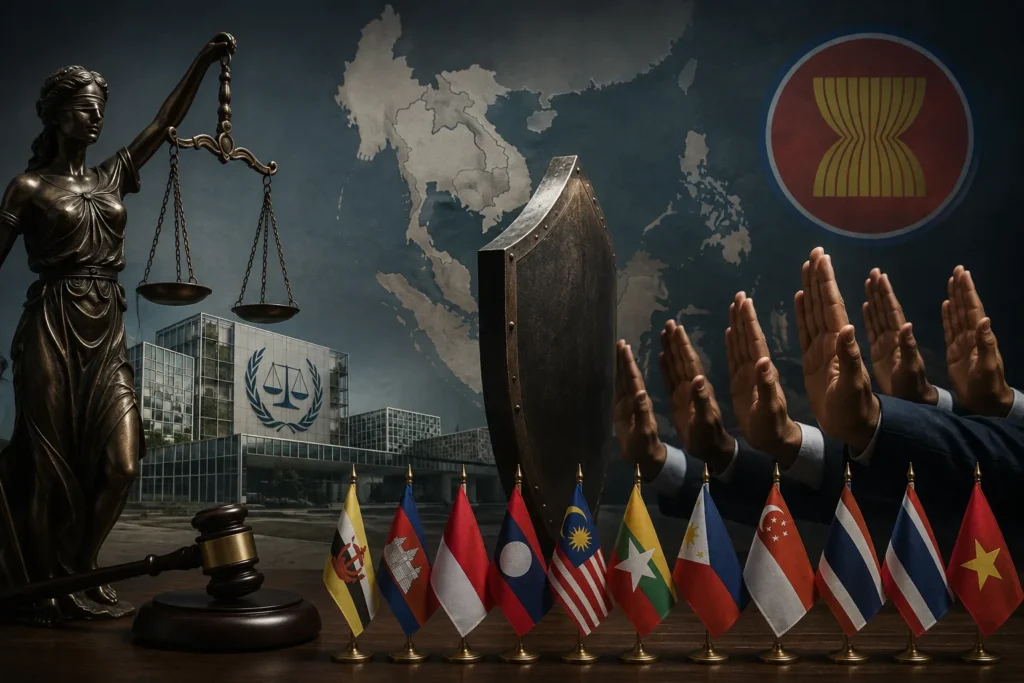
Cambodia ratified early, in April 2002. Timor-Leste joined the Statute in September 2002 and brought that status into ASEAN upon its admission. The Philippines ratified in 2011 but withdrew under President Rodrigo Duterte, with the withdrawal taking effect on 17 March 2019. Thailand signed the Statute in 2000 but has never ratified it.
Malaysia deposited an instrument of accession in 2019 under then-Prime Minister Mahathir Mohamad but withdrew it before it entered into force, citing constitutional and monarchical concerns. Indonesia, Singapore, Vietnam, Brunei, Laos, and Myanmar have neither signed nor ratified.
This pattern reflects longstanding regional skepticism expressed even at the 1998 Rome Conference. Delegations from Indonesia, Malaysia, and Vietnam emphasized state consent, complementarity with national courts, and independence from political bodies such as the UN Security Council. Concerns about external interference, prosecutorial overreach, sovereignty, and potential politicization have persisted.
The Duterte Case
The most prominent ICC matter involving an ASEAN national is the action against former Philippine President Rodrigo Duterte. The ICC’s Office of the Prosecutor opened a preliminary examination into alleged crimes linked to his signature “war on drugs” campaign in February of 2018. Jurisdiction was asserted for the period of membership, roughly November 2011 to March 2019.
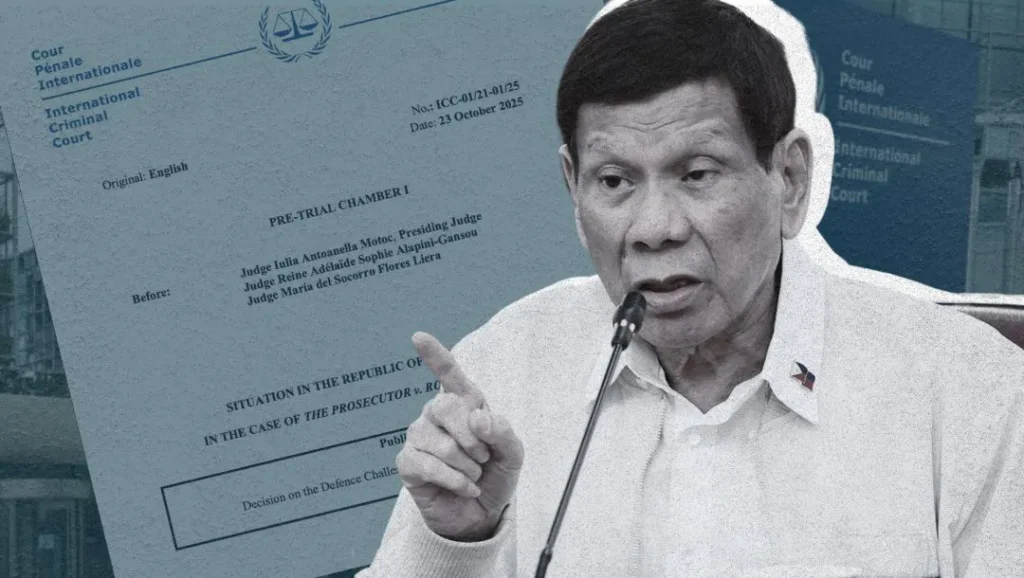
An arrest warrant was issued in early 2025. Philippine authorities arrested the former President and surrendered him to the court on March 12th of that year. He has since been detained at the ICC Detention Centre in Scheveningen. Pre-Trial Chamber I confirmed three counts of crimes against humanity, including murder and attempted murder, on 23 April 2026, finding substantial grounds to believe Duterte bore responsibility as an indirect co-perpetrator (and/or under other modes of liability) for killings between at least 1 November 2011 and 16 March 2019. The trial is scheduled to open on 30 November 2026 before Chamber III.
A related warrant was issued under seal on 6 November 2025 against sitting Philippine Senator Ronald “Bato” dela Rosa, Duterte’s former national police chief and a key figure in the anti-drug operations. The warrant, later unsealed, alleges criminal responsibility as an indirect co-perpetrator for crimes against humanity (including murder) in connection with at least 32 killings between July 2016 and April 2018. Dela Rosa became a fugitive after the warrant’s public confirmation in May 2026. Philippine authorities have pursued enforcement under domestic law permitting surrender for international crimes, while legal challenges by dela Rosa were rejected by the Supreme Court.
Myanmar and the Rohingya Issue
The other significant ICC situation with a Southeast Asian nexus is the Bangladesh – Myanmar investigation. Authorized in November 2019, it focuses on alleged crimes against humanity, specifically forced deportation and “persecution with deadly violence”, committed against the Rohingya population, with jurisdiction grounded in the fact that elements of the crimes occurred on the territory of Bangladesh, a State Party. The temporal scope covers acts from at least June 2010 onward that are linked to the 2016–2017 civil unrest in Rakhine State.
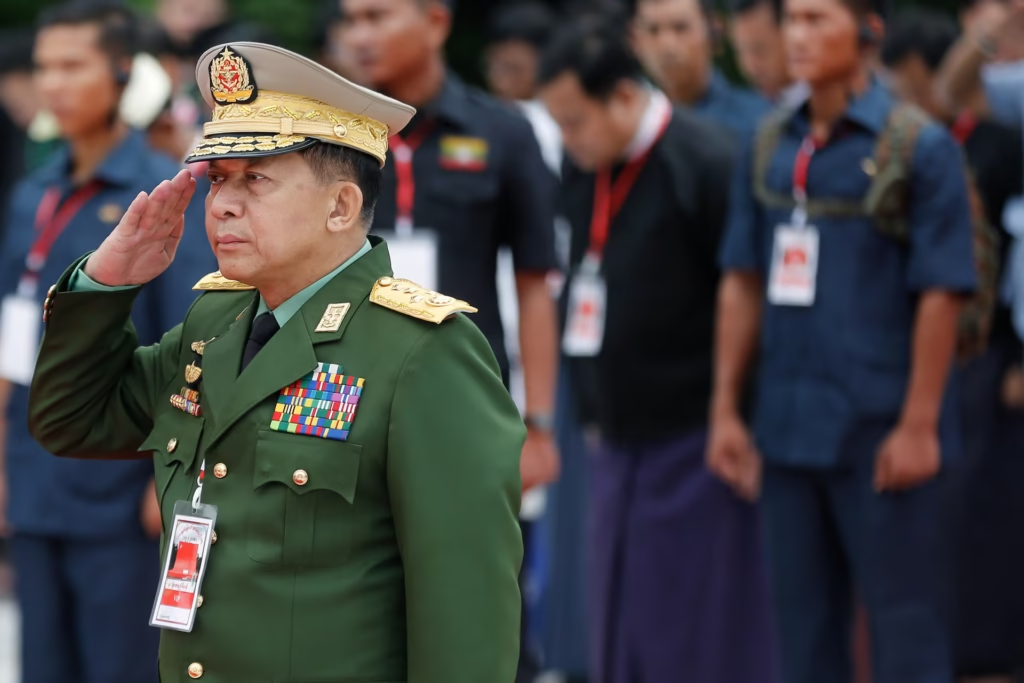
In November 2024, an arrest warrant against Senior General Min Aung Hlaing (Commander-in-Chief of the Myanmar Defense Services and later Acting President) for the crimes committed between 25 August and 31 December 2017 was applied for. Currently, the effort remains pending before Pre-Trial Chamber judges and no public arrest warrant has been confirmed, though warrants can be issued under seal. Myanmar is not, nor has ever been, a State Party, and the ICC has no general jurisdiction over its territory absent a UN Security Council referral or other linking factors.
ASEAN’s collective response to the Rohingya crisis and related accountability efforts has centered on the 2021 “Five-Point Consensus” (focused on cessation of violence, dialogue, and humanitarian access) rather than criminal justice. Official statements have generally avoided strong endorsement of ICC processes. Civil society groups, some parliamentarians, and individual member states have at times called for greater accountability, including Security Council referral.
Practical Interactions
ASEAN’s institutional posture emphasizes consensus, non-interference, and national sovereignty. When Duterte was arrested and transferred, regional commentary often urged neutrality and respect for legal process without collective endorsement or condemnation. Indonesia has publicly affirmed the importance of international law and institutions while noting it is not bound by the Rome Statute. Broader engagement remains limited: most members neither cooperate systematically with the ICC nor champion its expansion in the region.
Critics of the ICC in Southeast Asia frequently cite risks of selective justice, external pressure, and erosion of domestic authority. Supporters, including human rights organizations and some lawmakers, argue that domestic systems have often failed to deliver accountability for mass violence and that the Court fills a necessary gap under the principle of complementarity. The Duterte proceedings and the pending Myanmar-related application have tested these positions without producing a regional shift toward broader ratification or deeper institutional cooperation.
In practice, interaction is episodic and case-driven. Enforcement of warrants depends heavily on the willingness of individual states (or Interpol mechanisms) rather than ASEAN coordination. Universal-jurisdiction experiments in Indonesia and Timor-Leste signal growing domestic interest in accountability for atrocities, yet they remain exceptions within a political culture that continues to treat international criminal justice mechanisms with significant caution. The result is a region that engages the ICC selectively when national interests or external pressures align, while largely preserving distance from the Court as a standing institution.