
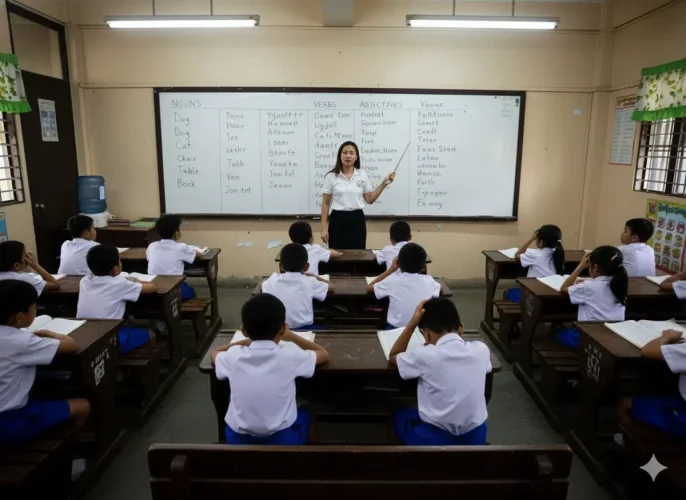
Nearly 2 billion people on the planet use English as an official, co-official, casual or trade language. In a country of a mere 120 million, 4 dialects are employed in classrooms, with English instruction as an afterthought. The Philippines must learn from history and Singapore’s success to reclaim her global competitiveness.
Legacy of the Thomasites

For nearly a century, the Philippines was hailed as a superior model for English proficiency. Filipino graduates were in high demand globally, with the country consistently topping English proficiency rankings in the region, and the world. This was made so by the US reversing the Spanish Catholic Church’s “Leyes De Indies” policy of promulgating ignorance among los peones, by educating all Filipinos, not just the Ilustrados or elites. From the day the Thomasite teachers came ashore in 1901 to man the new schools being built around the country, until a few years after the last US bases closed in the 1990’s, the Philippines was renown as a bastion of English in an otherwise Anglophobic Southeast Asia.
However, over the last thirty years, there has been a notable decline in overall English comprehension capabilities of Filipinos. This regression has raised concerns among educators, policy makers, and business leaders, especially as neighboring countries like Singapore continue to reap the economic advantages of strong English skills. Understanding the causes, implications, and solutions to this issue is urgent if the Philippines is to advance its place in an increasingly competitive global economy.
Former Leadership in English Proficiency

The Philippines’ reputation as a leader in English proficiency originates from the American Commonwealth period, when it was established as the primary language of instruction in schools. By the late 20th century, the country was recognized for producing a workforce highly skilled in English, enabling the country to become a preferred destination for outsourcing, business process management, and overseas employment. English fluency was seen not only as a marker of educational prestige but also a key to upward mobility and international opportunity.
As an example, look up “1954 Debate: Teenagers from Philippines, India, Norway, UK. Subject” on YouTube and watch the young Filipino, Johnny Antillon – then an 18-year-old high school senior exchange student in Pennsylvania. He dominated the conversation with his intellect and diction in a manner and fashion that most Americans would be proud of, even today. Such were the English abilities of everyday Filipinos in times past.
Factors Behind the Decline
Despite this strong foundation, several interconnected factors have contributed to the decline in English comprehension of late:
- Shifts in Education Policy: In the late 1980s and 1990s, educational reforms promoted the use of Filipino and regional languages as mediums of instruction, especially in the early grades. While these policies aimed to foster national identity and inclusivity, they in fact reduced consistent exposure to English in academic settings.
- Socio-Cultural Shifts: The rise of local media, entertainment, and digital content in Filipino and other vernaculars has diminished the daily use of English outside the classroom. English is increasingly perceived as elitist or unnecessary in everyday life, further reducing motivation and opportunities for practice.
- Reduced English Exposure and Practice: With less emphasis on English in both homes and schools, students have fewer chances to develop advanced comprehension and communication skills. This reduction in immersive English environments has led to lower proficiency across generations.
Why English Proficiency Matters
The decline in English skills has direct and significant implications for the Philippine economy. The country’s competitiveness in manufacturing, technology, and international trade heavily relies on a workforce that can communicate effectively in the universal language. As proficiency wanes, the Philippines risks losing its edge to other countries where English education is prioritized. Furthermore, limited proficiency can restrict access to high-quality information, global employment opportunities, and participation in international markets. The economic cost of not addressing this issue is substantial, from lost investments to diminished income for Filipino workers.
Singapore as a Model

Singapore provides a compelling example of how sustained commitment to English-language education can drive economic success. Despite its multicultural and multilingual society, Singapore has maintained English as the main language of instruction and administration. On the day of independence, the De Facto Father of the Lion City, Lee Kwan Yew, famously said, “You Chinese, Malays, Indians and Anglos must all choose what the national language will be… AS LONG AS IT IS ENGLISH!”
This policy has fostered not only high solid proficiency but also social cohesion and global competitiveness. Singapore’s workforce is consistently ranked among the world’s best in English, attracting multinational companies and enabling citizens to thrive in international arenas. The country’s GDP per capita and innovation indices reflect the tangible benefits of this approach, underscoring the link between language policy and economic prosperity.
Reverting to English and Promoting Daily Life Use
To arrest and reverse the decline in English proficiency, the Philippine government should consider a decisive policy shift:
- Restore English as the Primary Medium of Instruction, reinstating it as the main language in schools, especially for science, mathematics, and other core subjects, to ensure that students develop strong comprehension and communication skills from an early age.
- Promote English in Daily Life beyond the classroom, government and private sector to increase the visibility and use of English in media, public spaces, and professional settings. Initiatives could include English-language campaigns, reading programs, and incentives for English proficiency.
- Invest in Teacher Training and Resources to insure the installation of well-trained instructors and updated learning materials. Continuous professional development and support are essential to guarantee high-quality English instruction.
- Foster Positive Attitudes Toward English with public messaging that emphasizes proficiency while showing compatibility with national identity, NOT something to be fearful (“nosebleed”) or ashamed of (bullying or chastising by others who are less proficient).
A Call to Action
The Philippines stands at a crossroads. The decline in English comprehension is not just an educational issue but a national concern with far-reaching economic and social consequences. By learning from its own history and the example set by Singapore, the Philippines can reclaim its position as a regional leader in English proficiency. The time to act is now: policy makers, educators, and society must work together to restore the central role of English in education and daily life, ensuring that future generations are equipped to compete and succeed globally.