
Working Paper · Comparative Constitutional Politics
Republika ng Pilipinas
Academic Analysis of Potential Philippine Divestiture
Impeachment, legitimacy, and the political unbundling of a unitary republic
Clark Field, Pampanga, Philippines · September 2026
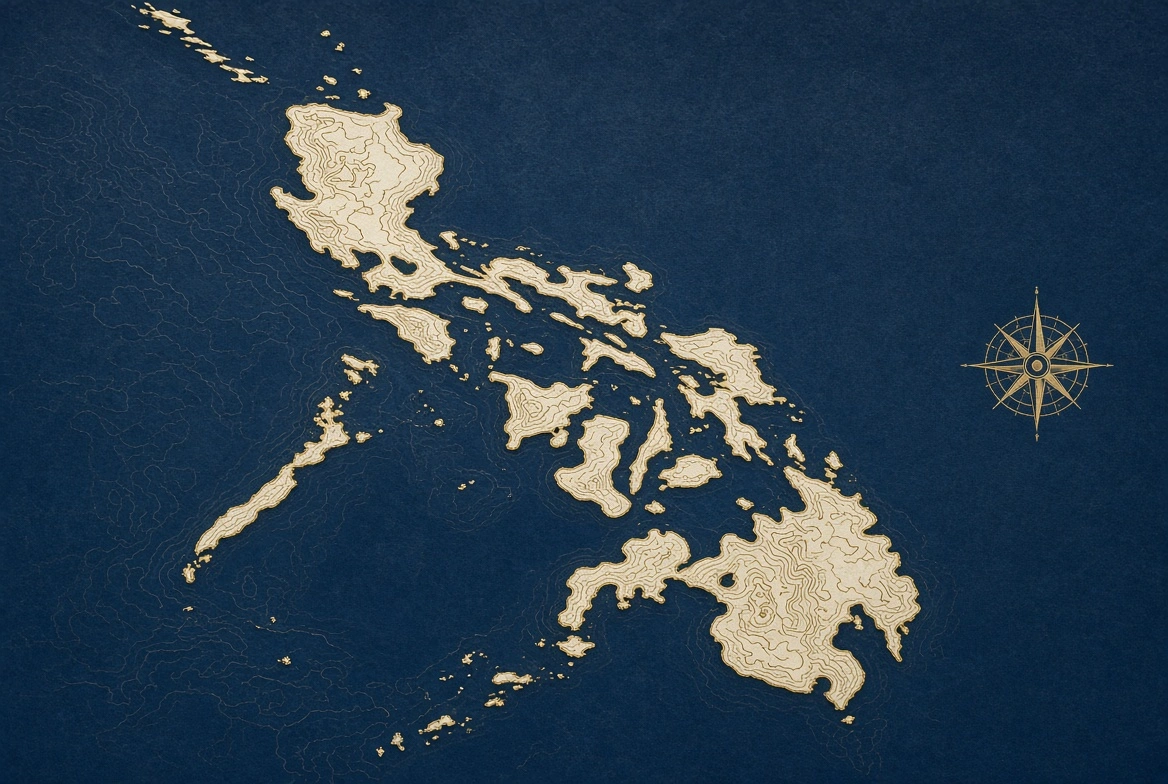
Abstract
A Senate conviction of Vice President Sara Duterte would — initially — be a constitutional event, not a territorial one. Article XI of the 1987 Philippine Constitution limits the penalty to removal from office and perpetual disqualification from public office. It does not authorize secession, partition, or a new federal map. “Divestiture” in this study therefore means the political unbundling of the unitary Philippine state, or the weakening of Manila’s claim to speak for all island groups after the leading southern presidential candidate is legally nullified.
This paper argues that conviction would raise the probability of regional defiance, especially in Davao and parts of Mindanao, but would not by itself produce new internationally recognized states within five to ten years. The more likely sequence is: (1) a legitimacy crisis framed as “Manila lawfare”; (2) intensified VisMin versus Luzon bloc politics; (3) pressure for federalism or BARMM hardening; and (4) rival governments with a fractured AFP or a refused 2028 election. Only then would provincial and regional lines become de facto borders.
Core Claim
Conviction divests a notable, southern political family of the vice presidency and a path to Malacañang. It does not, by constitutional operation, divest the Republic of Mindanao or the Visayas. The pathway from courtroom to map runs through legitimacy, not through Article XI.
1. Terms and method
Divestiture is used analogically. In corporate law it is the sale or spin-off of a subsidiary. For the purpose of this study, it is the spin-off of political territory from a unitary republic — the loss of monopoly over taxation, security, and external representation in some regions.
The method is scenario analysis grounded in four fixed points:
- the 1987 Constitution’s impeachment clause and the pending Senate trial;
- existing administrative regions and the 2017–2018 federal drafts;
- BARMM as the only functioning proto-state inside the Republic;
- documented north–south electoral geography of the Marcos–Duterte split.
Scenario Weights in the figures that follow are planning priors, not econometric forecasts. They encode the paper’s judgment that Philippine dynasties usually recentralize after personnel shocks, and that high-intensity partition requires additional failures of the fiscal center and the security forces.
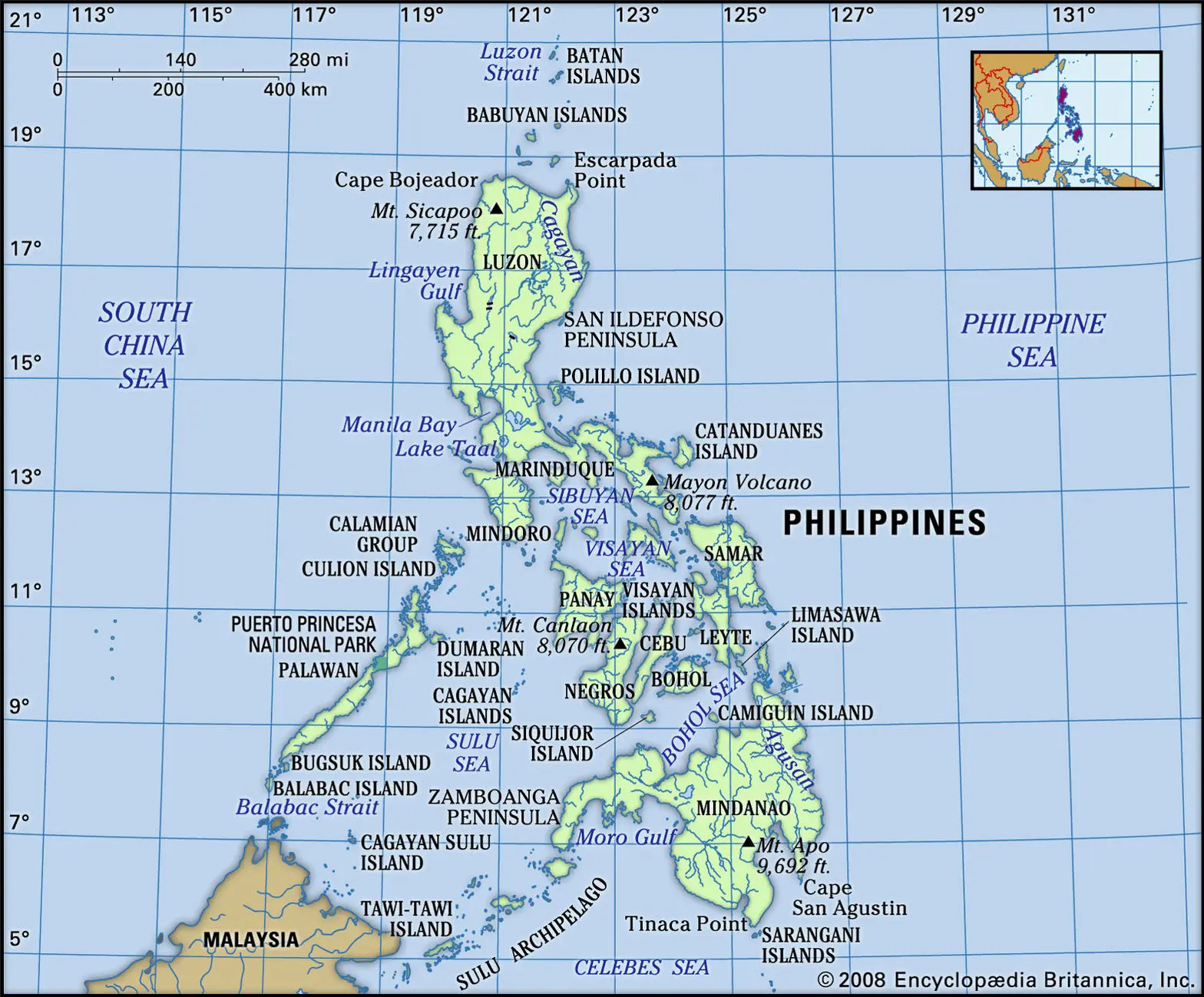
Figure A. The existing map. Any “divestiture” would be drawn on regions, provinces, and BARMM — not on a clean Luzon–Visayas–Mindanao triptych.
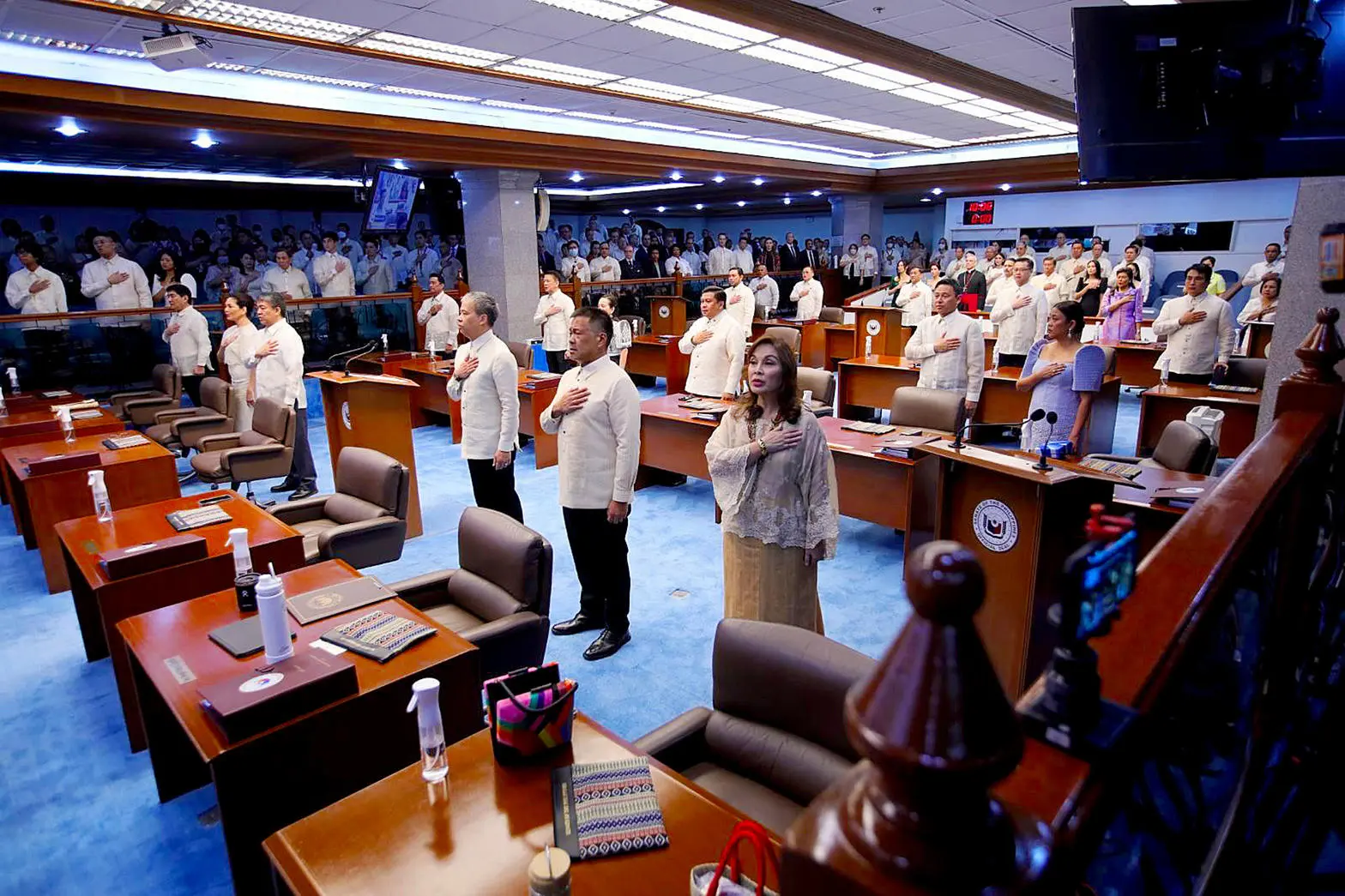
Figure B. The Senate sitting as an impeachment court. Article XI supplies removal and disqualification only.
The current dispute over whether “two-thirds of all the Members” means 16 of 24 or two-thirds of qualified senator-judges is itself a preview of the crisis: the meaning of the center’s rules is already contested. A conviction obtained after lowering the denominator would be legally potent in Manila and politically radioactive in Davao.
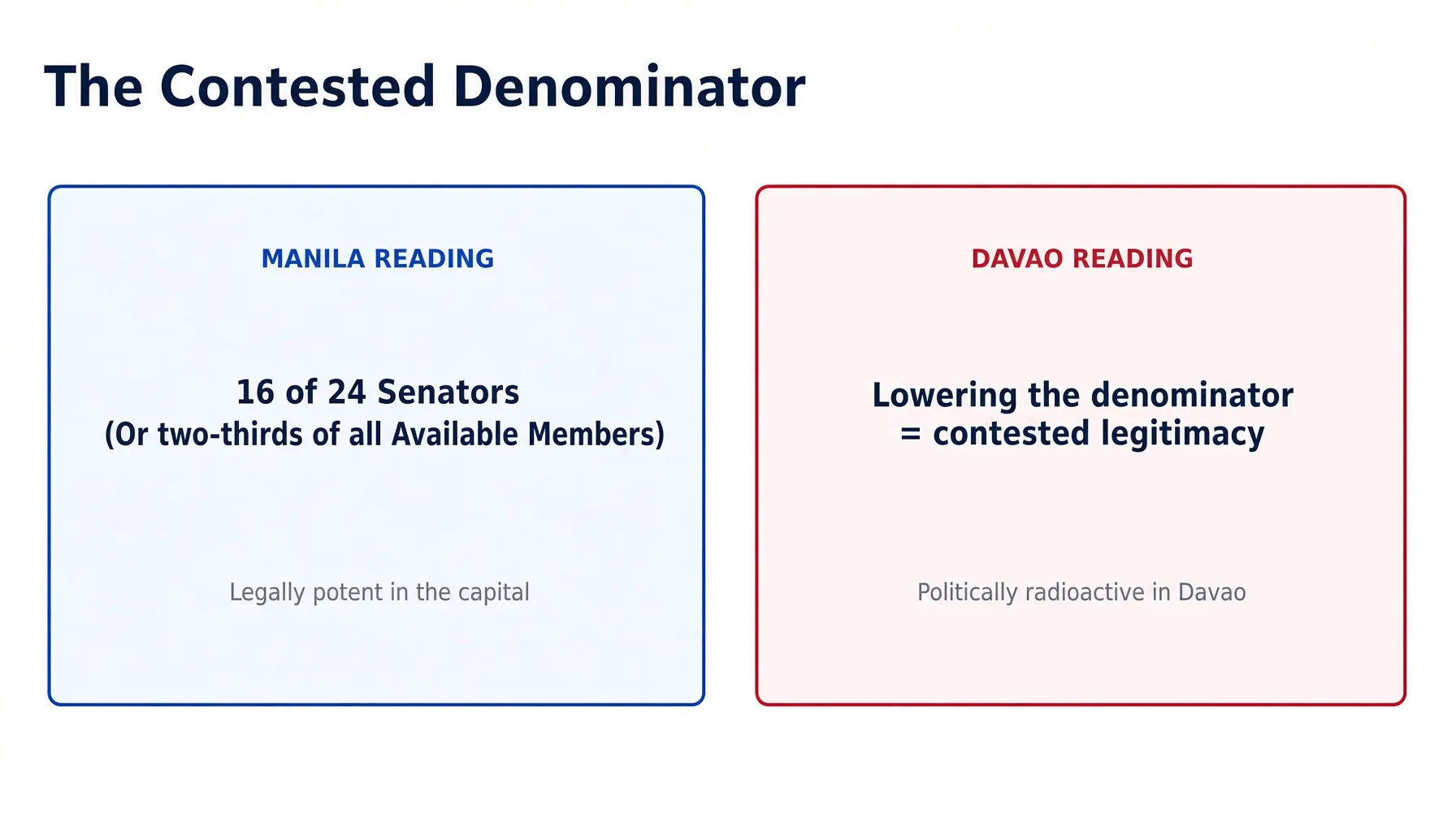
Figure C. The contested denominator. Procedure at the center is already a territorial argument.
3. Why it is territorially loaded
Philippine presidential coalitions have long been geographic. Marcos is associated with Ilocano northern Luzon; Duterte with Davao and a Visayan-speaking south. That is campaign branding, but it maps onto real resentments about “imperial Manila,” tax transfers, and ethno-linguistic identity.
A conviction would be read in two incompatible ways — and a third, mixed reading in the Visayas.
Incompatible readings of a conviction
| Audience | Reading |
|---|---|
| Manila / much of Luzon | Accountability; blocking a 2028 successor who threatened the President |
| Davao / parts of Mindanao | Dynasty war; ICC plus impeachment as a double strike on one family and one island |
| Cebu / Western Visayas | Mixed; many Visayan House members already voted to impeach |
Mindanao solidarity is not automatic. Forty-one of 61 Mindanao House members voted to impeach. A popular vice president is not the same thing as a separatist army. The Duterte machine is strongest as a national populist brand that happens to be based in Davao, not as a ready-made independence movement. Secession talk after Rodrigo Duterte’s arrest has been described as “ghosts” and political theater more than an organized project.
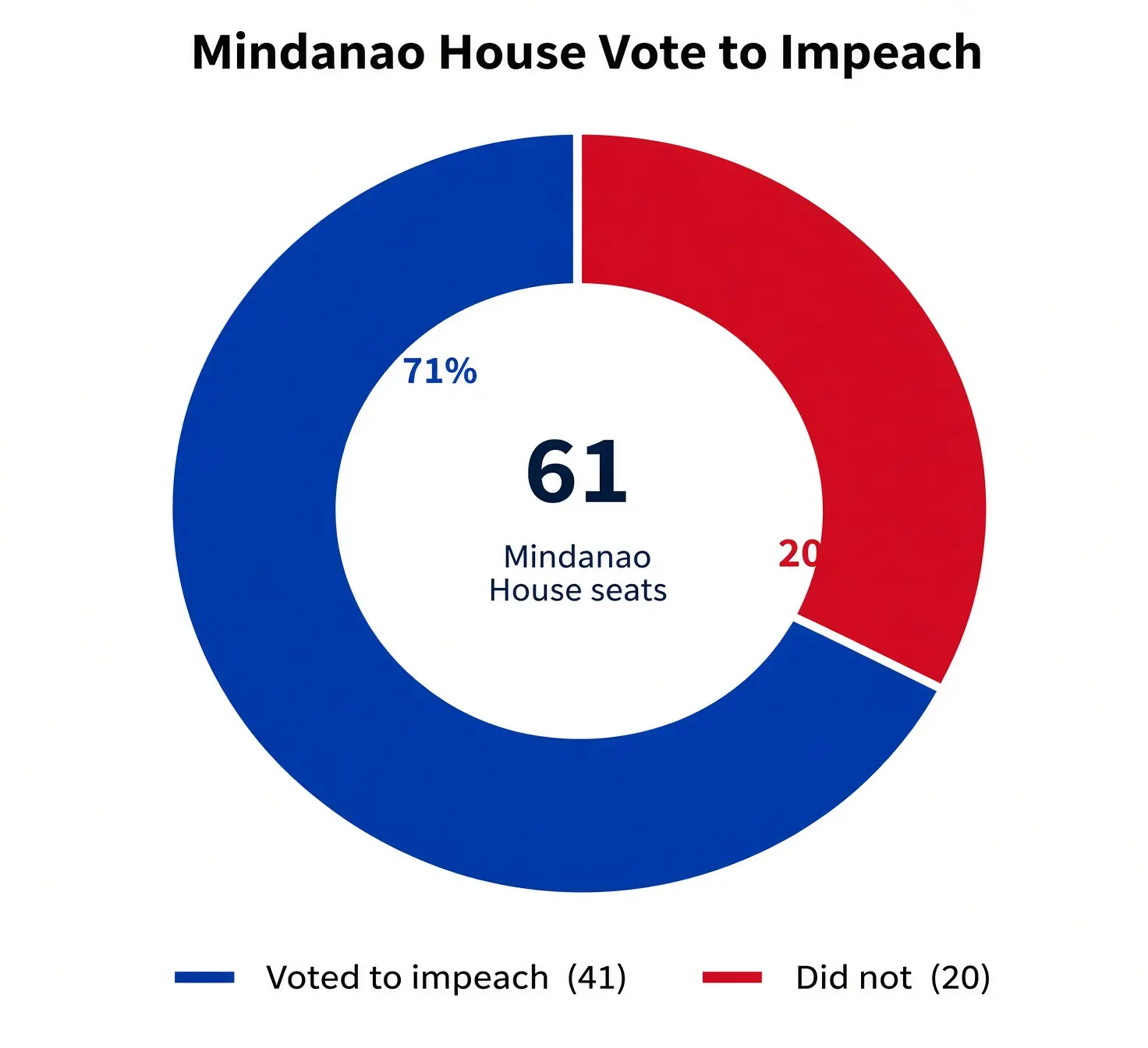
Figure D. Mindanao as a bloc.
The territorial risk is therefore narrative, then institutional, then — only if those fail — fiscal and potentially armed.
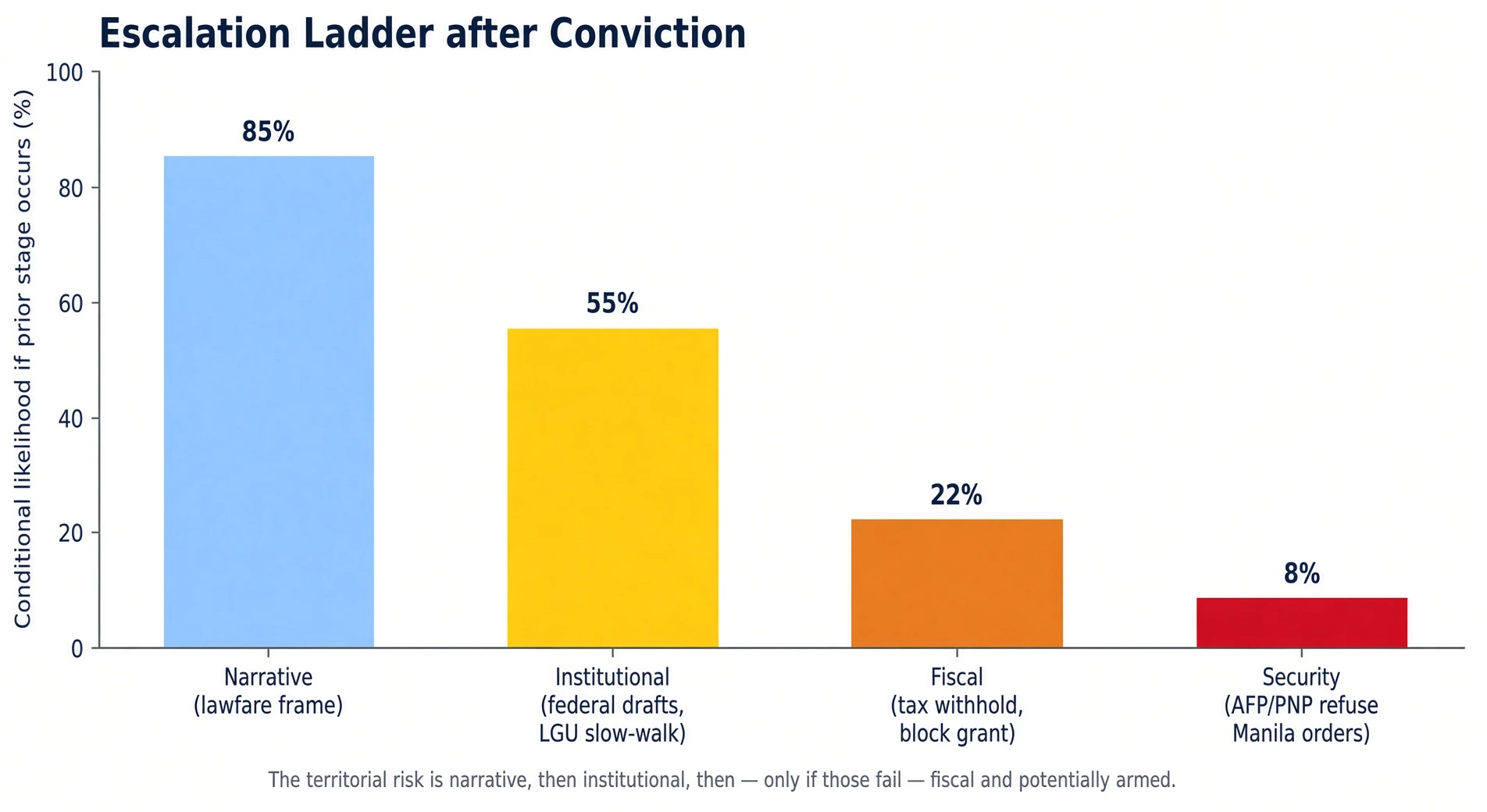
Figure E. Escalation is sequential. Each rung is harder than the last.
4. Three intensities of divestiture
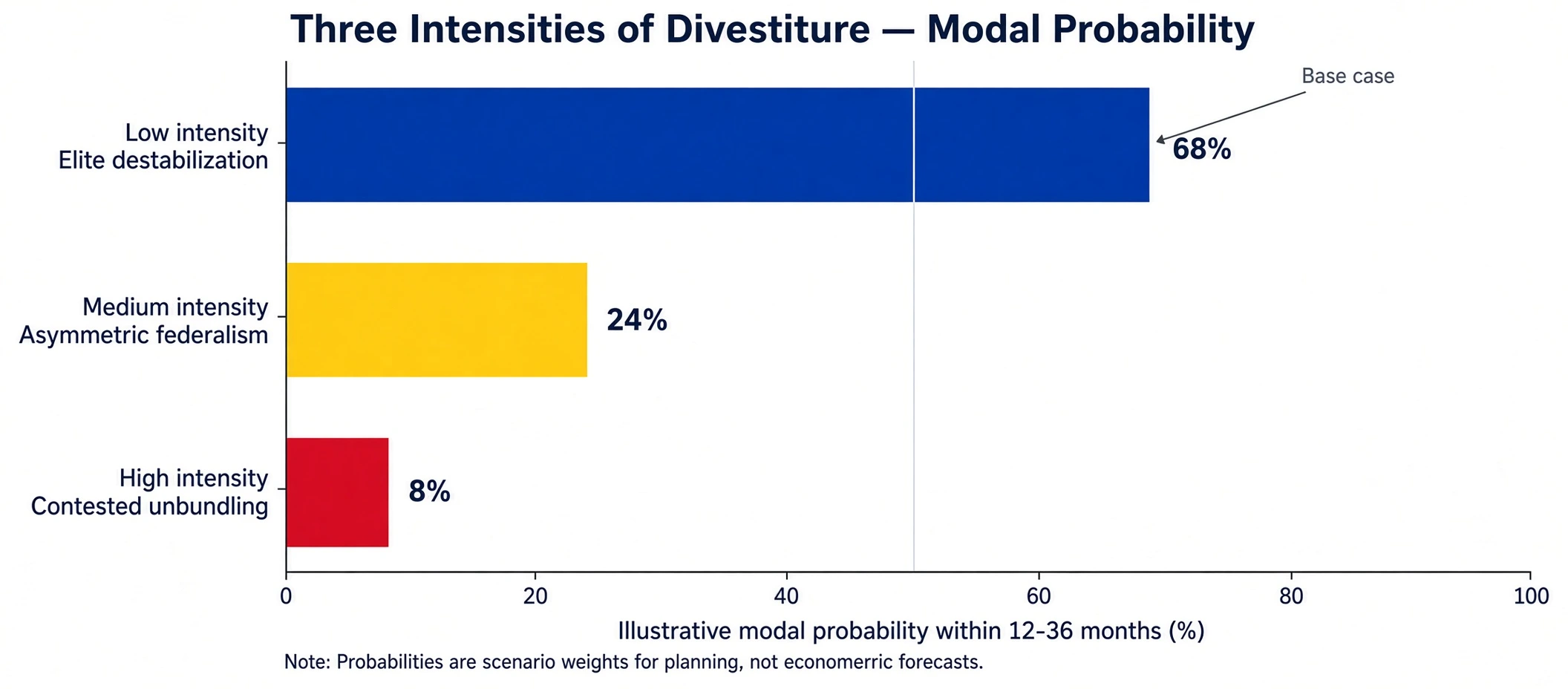
Figure F. The base case is elite destabilization. Partition is a tail risk.
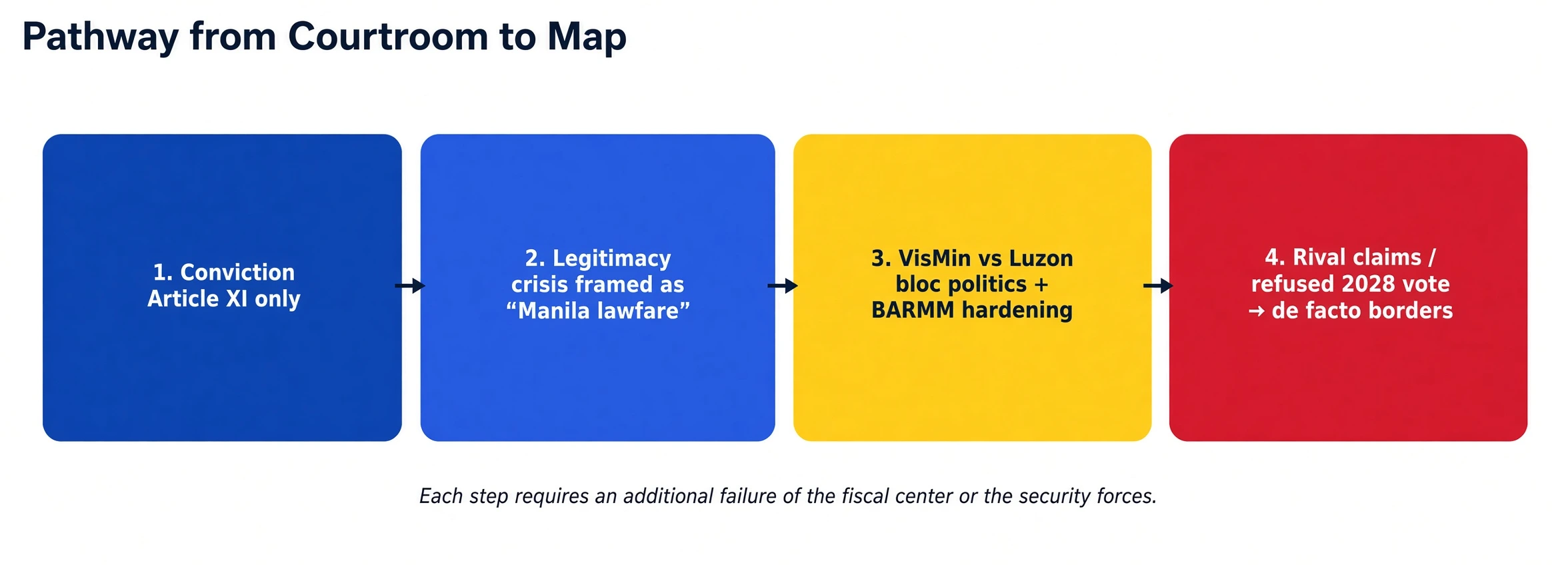
Figure G. From courtroom to map — each arrow is a political failure, not a constitutional clause.
4.1 Low intensity (base case): elite destabilization
Conviction occurs. Protests in Davao and online VisMin rhetoric spike. Sebastian Duterte or another family potentate becomes the 2028 proxy. PDP-Laban revives federalism as the legal substitute for exit. Manila appoints a vice president, keeps the dollar pipeline and the AFP intact, and buys loyalty from governors with budget releases.
Territorial result: none. The map is unchanged. “Divestiture” is limited to the Duterte brand being spun off from the formal state while remaining a regional political firm.
This is the most probable 12- to 24-month outcome. Philippine dynasties usually recentralize after such shocks.
4.2 Medium intensity: asymmetric federalism under duress
Conviction plus a second insult — a new arrest order treated as persecution, a disputed 2028 election, or a Supreme Court fight over the vote threshold — produces coordinated noncompliance short of independence:
- Davao City and allied Mindanao LGUs slow-walk national directives.
- BARMM treats Manila as a treaty partner rather than a superior, especially if BARMM parliamentary politics are already unstable.
- Cebu bargains for the re-establishment of “Sugbu” (the ancient, pre-colonial name for the island) through a fiscal deal without leaving.
- Federal drafts from 2018 (17–18 regions, or the older 11-block Pimentel map) are dusted off as an assuagement formula.
Territorial result: de facto federacy. Borders follow existing regions. Passports and the peso stay national. This is divestiture of authority, not of sovereignty.
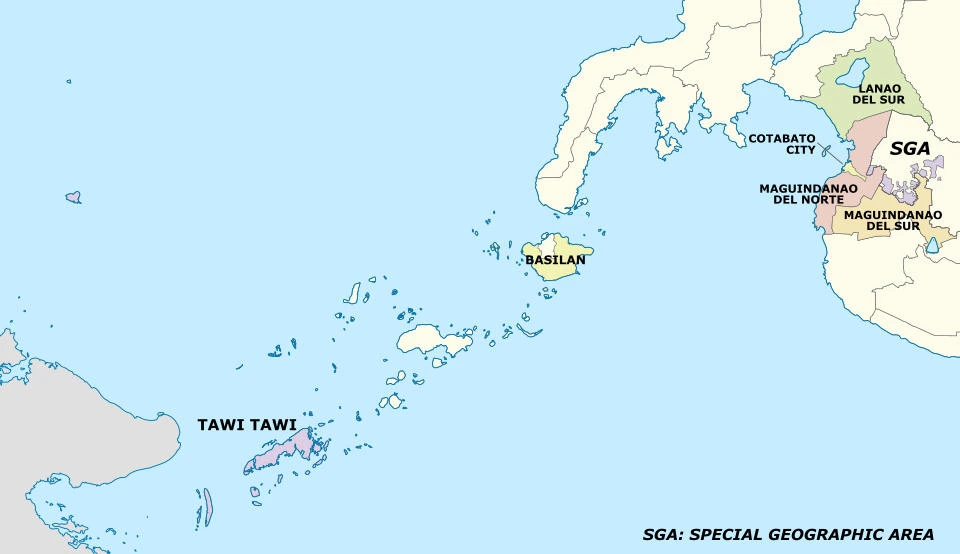
Figure H. BARMM is the only functioning proto-state inside the Republic — and the first unit that could look like a state because it already has a parliament.
4.3 High intensity: contested unbundling
High intensity requires a third failure: the AFP Southern Command or PNP regional directors stop taking Manila’s orders; rival “acting presidents” appear; or a region stops remitting taxes and is not immediately coerced. Then the map discussed in numerous other papers becomes operational.
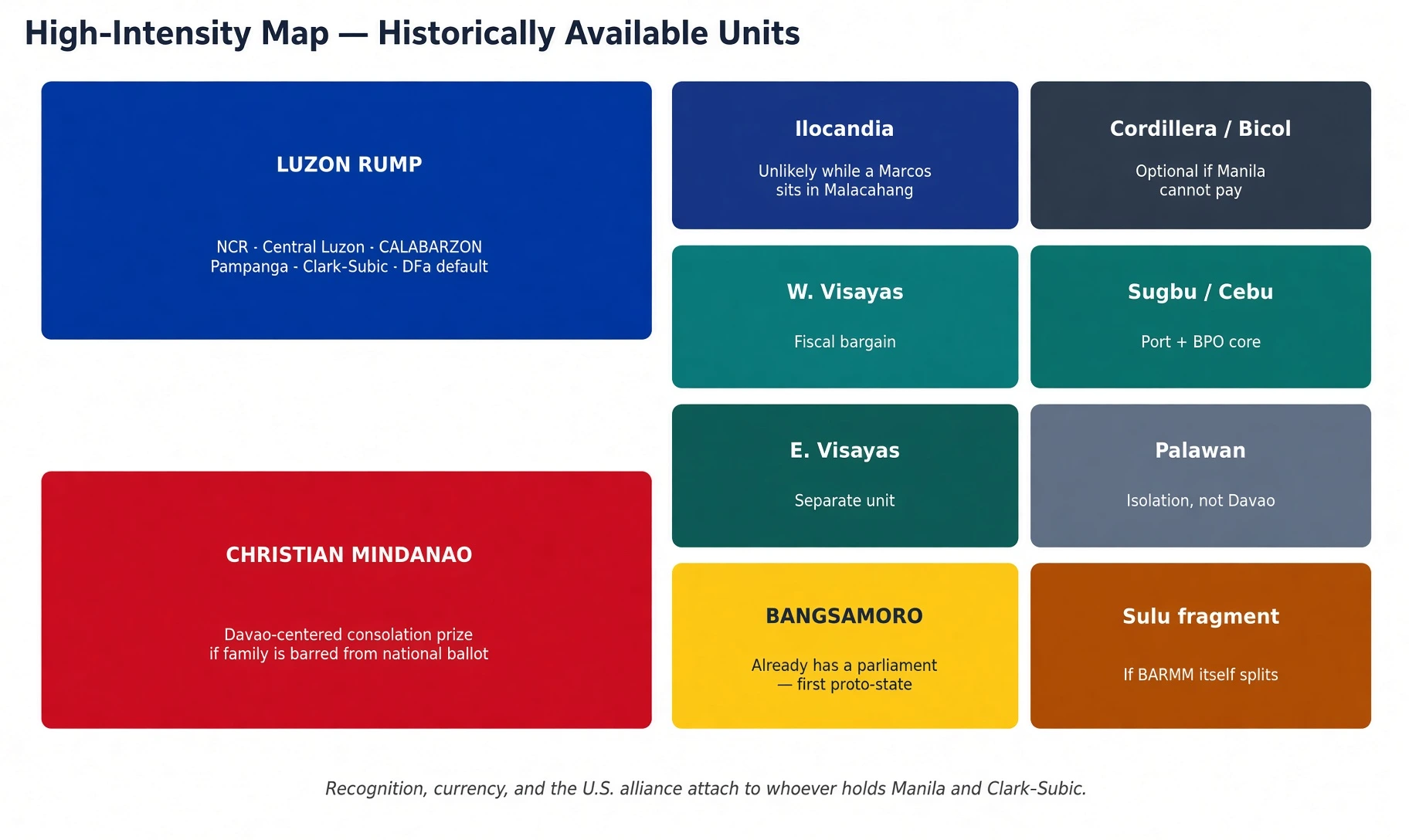
Figure I. Historically available borders are regions, provinces, and BARMM — not a three-island cartoon.
Units that become thinkable only after a third failure
| Unit | Logic |
|---|---|
| Luzon rump / Republic of the Philippines | NCR, Central Luzon, CALABARZON, Pampanga, much of MIMAROPA; keeps DFA recognition by default |
| Ilocandia / Northern Luzon | Only if Ilocos peels from a collapsing Manila — unlikely while a Marcos sits in Malacañang |
| Cordillera, Bicol | Optional spin-offs if Manila cannot or will not pay |
| Western / Central / Eastern Visayas | Three units, not one “Visayas.” Central Visayas as Sugbu or Kabisayaan |
| Christian Mindanao (Davao-centered) | The Duterte consolation prize if the family is barred from the national ballot |
| Bangsamoro | First unit able to look like a state because it already has a parliament |
| Sulu Sea fragment | If BARMM itself splits |
| Palawan | Isolation, not Davao politics, would drive it |
Even in this case, recognition, currency, and the U.S. alliance would attach to whoever holds Manila and Clark–Subic, not whoever controls Mindanao. An independent Davao might request that China set up military facilities there to counter attempts by Manila to regain the territory — a geopolitical overlay, not a constitutional one.
5. Pampanga under a Duterte-conviction shock
Pampanga is not a Duterte ethnic homeland. It is Kapampangan, industrial, and wired to Manila by NLEX/SCTEX and Clark. A conviction crisis would be consumed there as national television fodder and Freeport logistics, not as a call to join Mindanao.
In all three intensities Pampanga stays with the Luzon core. The contested belt would be Tarlac and Nueva Ecija (an Ilocano–Kapampangan–Tagalog mix), not Angeles or San Fernando.
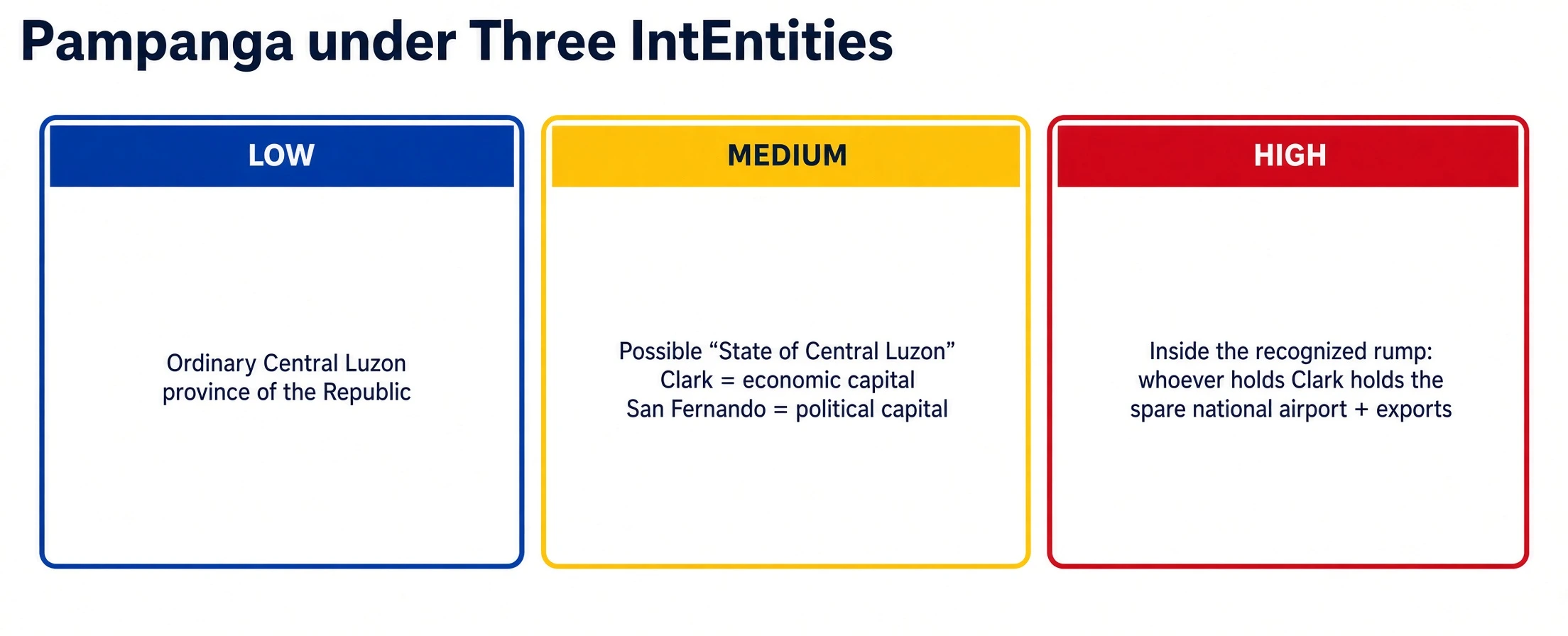
Figure J. Whoever holds Clark holds the spare national airport and a large share of export manufacturing.
6. Economic meaning of “divestiture”
If the word is taken seriously as an asset split, the high-intensity assignment of strategic holdings is not symmetric. The internationally recognized rump keeps the airports, the alliance infrastructure, and the default claim on OFW identity documents. Mindanao as a whole has been a net recipient of national funds. A Davao republic that “wins” politically can still lose fiscally. That is the strongest structural brake on high-intensity divestiture.
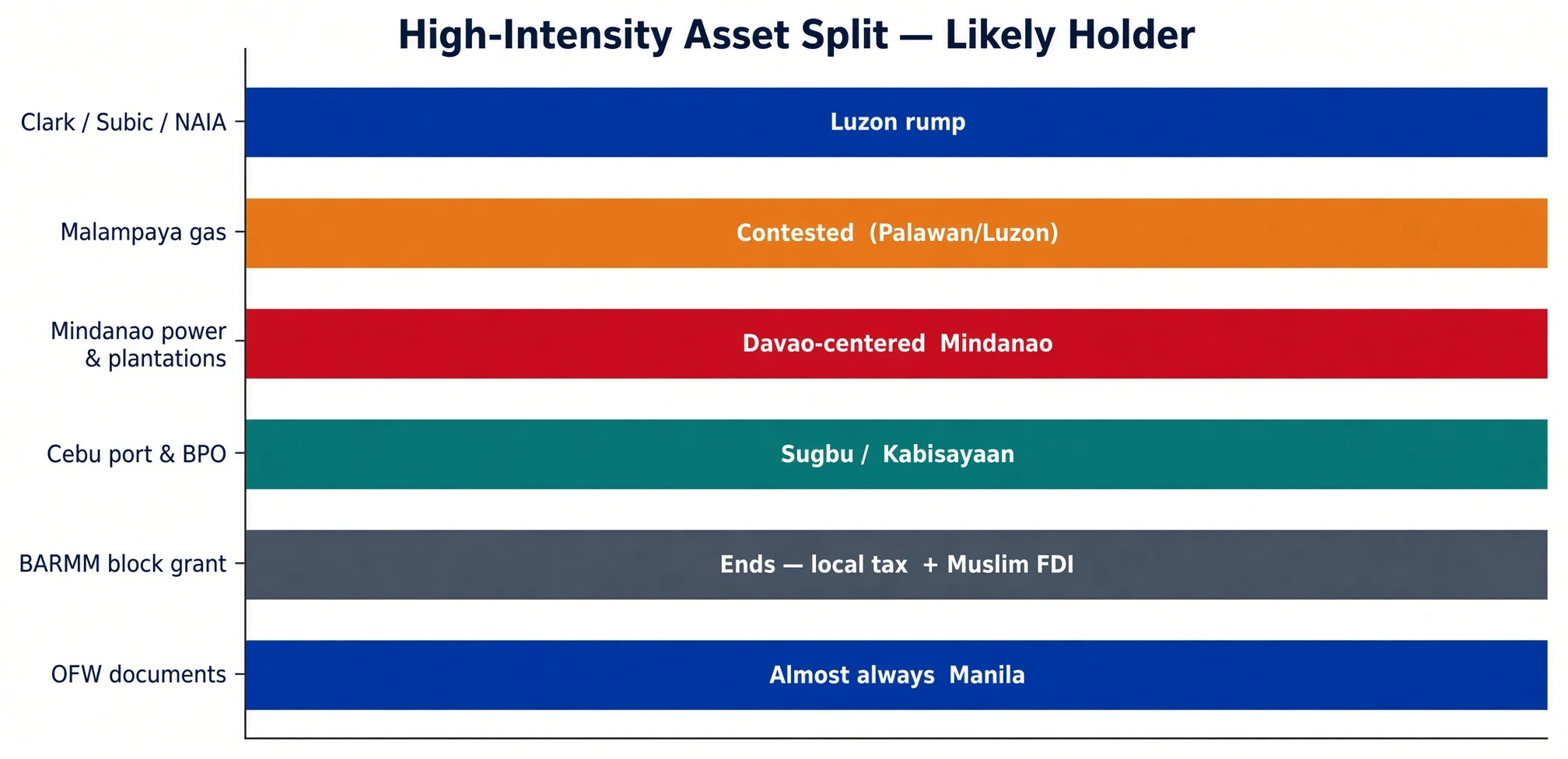
Figure K. Political victory in Davao is not a fiscal victory.
Strategic assets after a high-intensity split
| Asset | Likely holder |
|---|---|
| Clark, Subic, NAIA | Luzon rump |
| Malampaya | Contested (Palawan / Luzon) |
| Mindanao power and plantations | Davao-centered Mindanao |
| Cebu port and BPO | Sugbu / Kabisayaan |
| BARMM block-grant logic | Ends; Cotabato must tax locally; foreign investment from Muslim countries |
| OFW identity documents | Whoever the host country still treats as “Philippines” — almost always Manila |
7. Conclusion
A conviction of Sara Duterte would divest the Duterte family of the vice presidency and a legal path to Malacañang. It would not, by constitutional operation, divest the Republic of Mindanao or the Visayas.
The pathway from courtroom to map runs through legitimacy, not through Article XI. Only if conviction is successfully framed as the disenfranchisement of an entire island group, and if Manila cannot buy or coerce governors afterward, do regional lines harden into borders. The historically available borders are the ones already drawn for federalism and autonomy: regions, provinces, and BARMM — not a Luzon–Visayas–Mindanao triptych.
The academically conservative finding
- Conviction is a personnel and succession shock.
- The modal territorial response is federalist bargaining and Davao defiance short of independence.
- A true partition remains a tail risk requiring additional failures of the security forces and the fiscal center.
- Pampanga, Clark, Subic and Central Luzon remain inside whatever entity still calls itself the Republic of the Philippines.
Note on method and limits
This is a working paper in comparative constitutional politics, not a prediction market or a legal brief. Scenario probabilities are illustrative weights for planning. House-vote counts for Mindanao are as stated in the source analysis. Nothing in Article XI authorizes territorial change; any map that follows a conviction would be produced by politics after the verdict, not by the verdict itself.
Wagner, R. T., and Aegis, R. B. Clark Field, Pampanga. September 2026.
Cites and References
Constitutional statutes
Republic of the Philippines. 1987. The 1987 Constitution of the Republic of the Philippines, Article VII (Executive Department), sec. 9. Official Gazette. https://www.officialgazette.gov.ph/constitutions/the-1987-constitution-of-the-republic-of-the-philippines/the-1987-constitution-of-the-republic-of-the-philippines-article-vii/ — Vacancy in the vice presidency: presidential nomination from Congress, confirmation by both Houses voting separately.
Republic of the Philippines. 1987. The 1987 Constitution of the Republic of the Philippines, Article XI (Accountability of Public Officers), secs. 2–3. Official Gazette. https://www.officialgazette.gov.ph/constitutions/the-1987-constitution-of-the-republic-of-the-philippines/the-1987-constitution-of-the-republic-of-the-philippines-article-xi/ — Two-thirds of all Members of the Senate; judgment limited to removal and perpetual disqualification.
Republic of the Philippines. 1991. Republic Act No. 7160, Local Government Code, secs. 284–286 (IRA / National Tax Allotment).
Republic of the Philippines. 1992. Republic Act No. 7227, Bases Conversion and Development Act (Subic Freeport; SBMA).
Republic of the Philippines. 2007. Republic Act No. 9400 (Clark Freeport Zone).
Republic of the Philippines. 2018. Republic Act No. 11054, Organic Law for the Bangsamoro Autonomous Region in Muslim Mindanao.
Impeachment record and the contested denominator
Angelo, Francis Allan L. 2026. “14 or 16″ Charter Framer Settles the Impeachment Math.” Daily Guardian, September 12.
Gavilan, Jodesz. 2025. “If the Vice President Is Impeached, Who Takes Over?” Rappler, February 5.
House of Representatives. 2025. Articles of Impeachment against Vice President Sara Z. Duterte. Full text via Philstar.com, June 13, 2025.
Philippine News Agency. 2026. “House Impeaches VP Sara Duterte with 257 Votes.” May 11. Four transmitted articles: confidential funds (₱612.5 million), unexplained wealth/SALN, bribery, assassination threats.
International Criminal Court. 2026. Case Information Sheet: The Prosecutor v. Rodrigo Roa Duterte. The Hague.
Electoral geography and the Mindanao House vote
Arguillas, Carolyn O. 2026. “‘Solid South’ No More: Only 8 of 61 Mindanao District Reps Voted against VP Sara’s Impeachment.” MindaNews, May 13.
Latoza, Guinevere. 2026. “MAP: Who Voted to Impeach Vice President Sara Duterte?” Philippine Center for Investigative Journalism, May 25. 41 of 61 Mindanao district members voted to impeach.
Gatmaytan, Bea. 2026. “How Mindanao’s Lawmakers Voted on VP Sara Duterte’s Impeachment.” MindaNews, May 12.
Escosio, Jan. 2026. “Visayas, Mindanao Back Sara Duterte Impeachment Push — Ridon.” Cebu Daily News, May 17. Visayas 43 of 50; Mindanao 41 of 61.
Federal drafts, BARMM, and fiscal structure
Consultative Committee to Review the 1987 Constitution. 2018. Power to the People: Bayanihan Federalism, Power to the Regions. Draft constitution (18 federated regions).
Pimentel, Aquilino “Nene,” Jr. 2018. “Nene Pimentel: ConCom Work Is Merely Recommendatory.” Philippine Daily Inquirer, July 26. Original 11- then 12-state map.
Congressional Policy and Budget Research Department. 2026. Review of Public Financial Management System for National Fiscal Transfer to BARMM. House of Representatives. Block grant = 5% of net BIR/BOC collections.
Bangsamoro Government. 2026. First regular parliamentary elections, September 14.
Clark–Subic and the Luzon core
Subic Bay Metropolitan Authority. 2026. “Aussie Ambassador Sees Subic’s Role in Luzon Economic Corridor.” June 3. Subic–Clark–Manila–Batangas corridor.
PortCalls Asia. 2026. “Pax Silica and the Luzon Economic Corridor.” September 8.
Comparative and interpretive
Associated Press. 2025. “Philippine’s Ex-President Rodrigo Duterte Arrested on ICC Warrant.” March 11.
Fernandez, Maria Carmen (Ica). 2025–26. “Exorcising Rodrigo Duterte and the Ghosts of Mindanao Secession.” Australian Outlook. Source for treating post-arrest secession talk as political theater rather than an organized project.
Supreme Court of the Philippines. 2001. Estrada v. Desierto, G.R. Nos. 146710-15.
Supreme Court of the Philippines. 2025. Duterte v. House of Representatives, G.R. No. 278353.