
Across ASEAN, trial by jury as understood in the Anglo-American common-law tradition is absent. Criminal and civil adjudication rests overwhelmingly with professional, appointed judges, sometimes supplemented by lay assessors in limited hybrid forms, but never by independent citizen (peer) juries determining guilt or liability. Given recent societal advancements in the region, there now exists good reason to review the policy.
This institutional uniformity is striking given the region’s diversity of colonial histories and political regimes. It is not the product of coincidence. Rather, it reflects a combination of transplanted legal traditions that never incorporated the jury, deliberate post-colonial choices to discard or restrict it, and pragmatic assessments of the social and educational conditions prevailing at the time of independence or nation-building.
Colonial Legacies
Most ASEAN jurisdictions inherited civil-law or hybrid systems in which individual judges investigate facts and apply the law. The Philippines received Spanish civil-law codes that privileged judicial determination; American colonial administrators briefly considered jury trials but ultimately rejected them as unsuitable at during that era due to pool limitations (education).
Thailand, never colonized, modernized its legal system in the late nineteenth and early twentieth centuries by borrowing continental European models that likewise centered on a professional magistracy. Indonesia retained the Dutch civil-law framework, while Vietnam, Cambodia, and Laos followed French or socialist variants that employed people’s assessors rather than autonomous juries.
Lee Kuan Yew’s Explicit Rationale
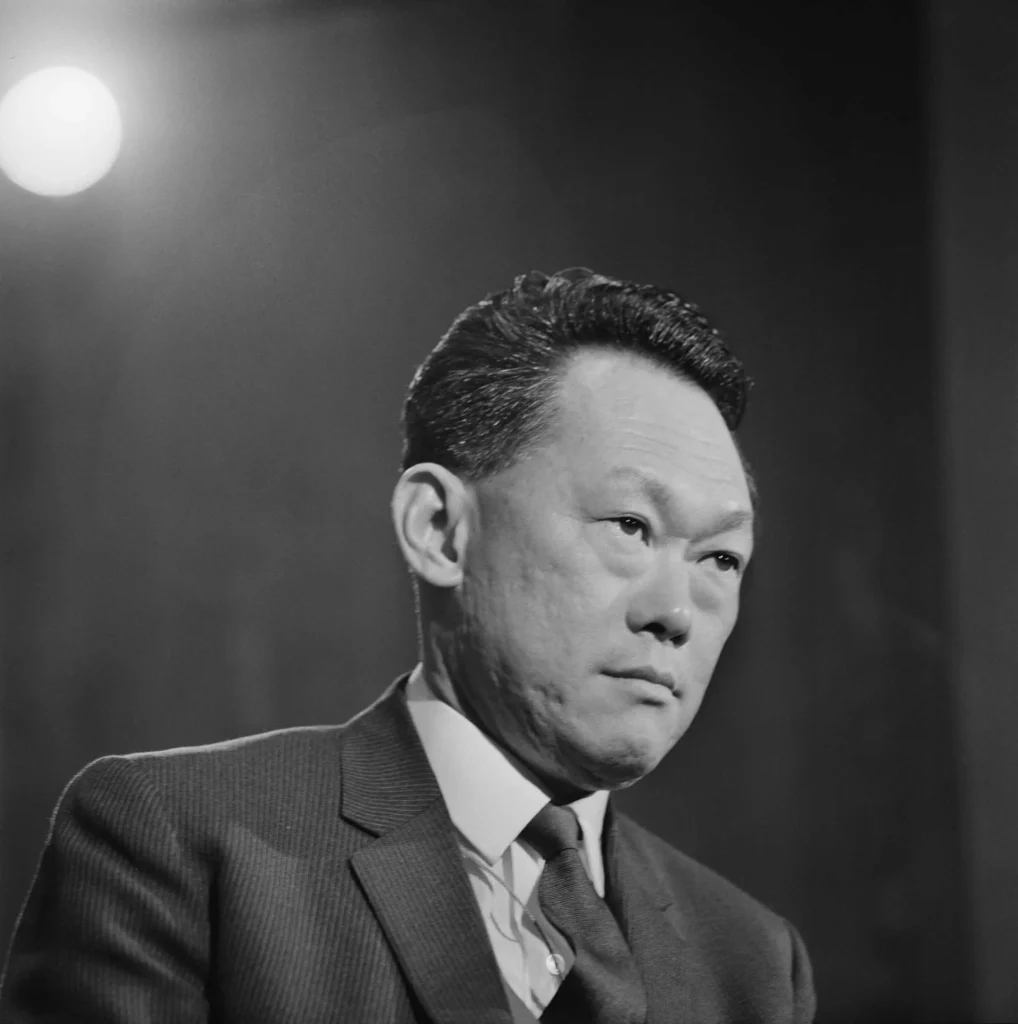
Singapore’s experience is the most thoroughly documented and ideologically articulated. Jury trial, already limited to capital offences after 1960, was abolished entirely by legislation that took effect in 1970. Lee Kuan Yew, then Prime Minister and a Cambridge-trained lawyer who had practiced at the Singapore Bar, drove the reform. His objections were both practical and cultural.
In his memoirs and public statements, he declared that he “had no faith in a system that allowed the superstition, ignorance, biases, and prejudices of seven jurymen to determine guilt or innocence.” He regarded the jury as an alien English implantation that functioned adequately only under conditions of high educational attainment and cultural homogeneity that Singapore lacked in the 1950s and 1960s.
Literacy rates hovered around 50–60 per cent; large sections of the population still operated within vernacular, religious, or communal frameworks that, in Lee’s view, rendered them susceptible to emotional appeals, ethnic solidarity, or superstitious reasoning. In a multi-racial, multi-religious society still recovering from communal violence, the risk that jurors would divide along ethnic or religious lines, or be swayed by counsel skilled in exploiting those divisions, appeared intolerable.
Changes Since the Mid-Twentieth Century
The empirical foundations of those mid-century judgements have shifted substantially. Adult literacy in Singapore now exceeds 97–98 per cent; tertiary attainment is among the highest in the world. Thailand and the Philippines have achieved near-universal basic literacy and have expanded secondary and higher education dramatically.
Middle-class strata have broadened. In the Philippines the middle-income share of the population rose from roughly 28 per cent in 1991 to nearly 40 per cent by the early 2020s, with markedly higher rates of college completion among that group. Thailand and Singapore already possess substantial middle classes with the cognitive skills, media literacy, and civic expectations that make informed lay participation more plausible than it was fifty or sixty years ago.
Democratic institutions, however imperfect, have also deepened in the Philippines and, with interruptions, in Thailand. Public demand for accountability and transparency in the justice system has grown. These developments reopen the question of whether some form of citizen participation in fact-finding could now serve legitimating and democratizing functions without reproducing the defects that justified abolition.
Prospects for Reintroduction
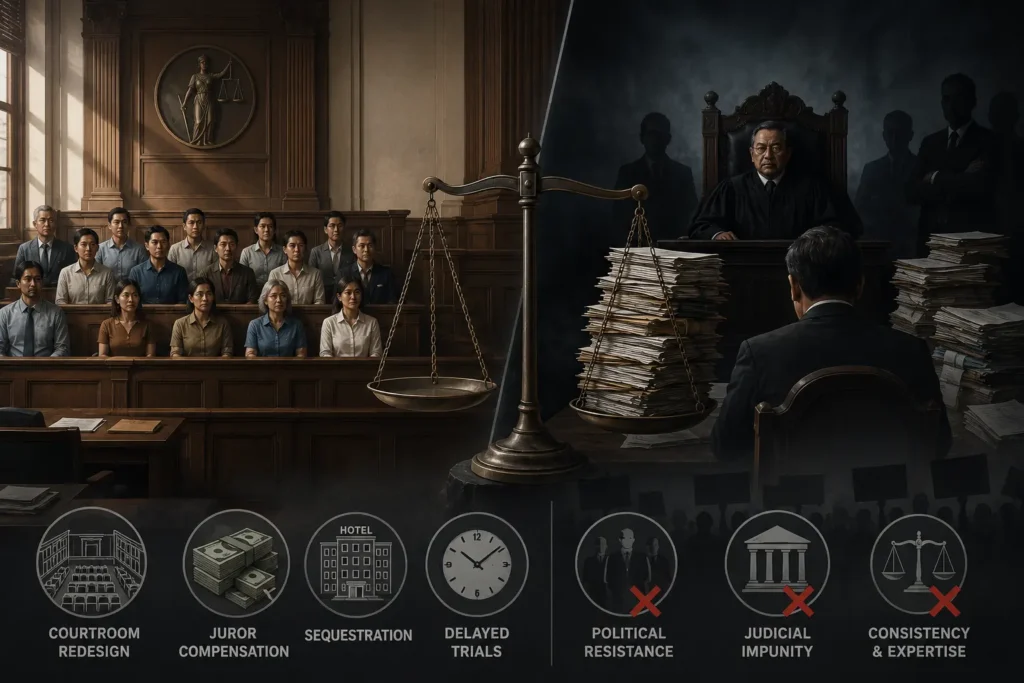
Any serious discussion of reintroduction must begin with realism. Classic twelve-member common-law juries deciding all serious criminal cases are hampered by logistical burdens, such as courtroom redesign, juror compensation, sequestration, and the risk of lengthening already substantial case backlogs. Political resistance from stodgy judicial establishments wishing to retain supreme authority with full impunity, as well as concerns about consistency and expertise persist.
In The Philippines, where the legal system already mixes civil-law codes with common-law procedural influences, and where democratic discourse is vigorous, limited jury trials could strengthen public ownership of justice outcomes and serve as a check on perceptions of elite or political influence of the bench. Principal obstacles are mostly fiscal and institutional. The existing backlog of cases and uneven judicial infrastructure would require notable investment, but these things are in no way insurmountable challenges.
In Singapore, the case is more delicate. The professional judiciary there has delivered high levels of efficiency, low corruption, and public confidence. Reintroducing any form of lay participation would require demonstrating that it enhances rather than dilutes these achievements. A carefully circumscribed pilot for capital crimes or especially complex cases, framed as an experiment in civic education rather than a repudiation of the existing system, might be politically viable provided government consensus formed around it. The multi-ethnic character of society remains a relevant consideration, though educational homogenization and strong national identity have reduced the intensity of the communal risks Lee identified 60 years ago.
In Thailand, political volatility and periodic military intervention complicate any reform. Yet the growth of an educated urban middle class and recurring public dissatisfaction with perceived judicial partiality create openings for hybrid lay participation as a confidence-building measure, provided it is insulated from partisan capture.
The Bottom Line
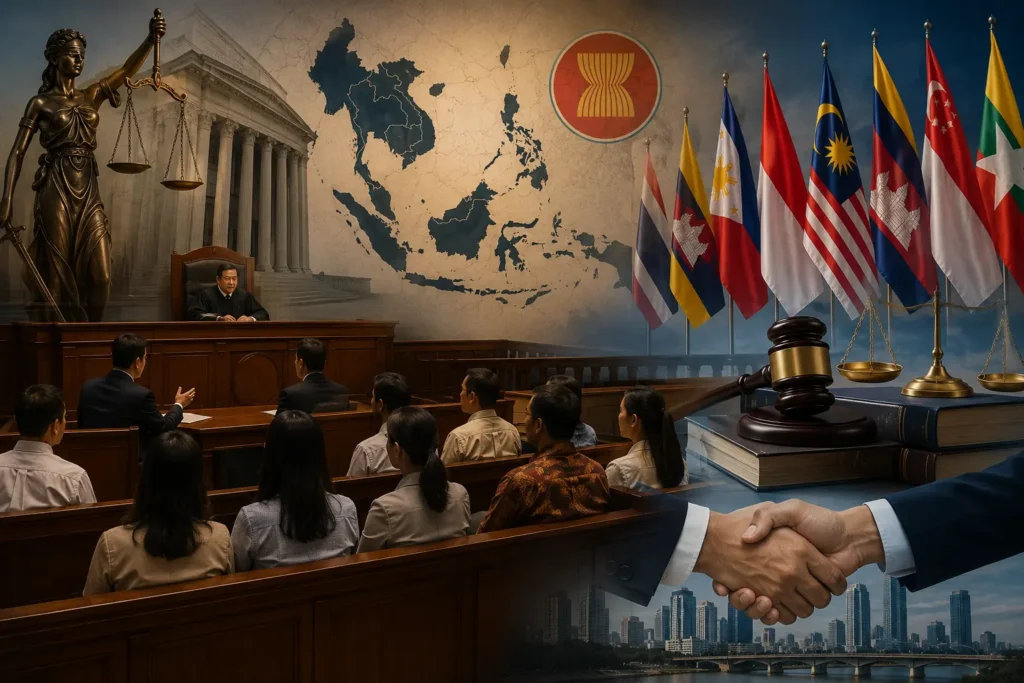
Reintroduction is not inevitable, nor is it necessarily desirable in every context. Unless managed properly, jury systems can sometimes be fraught with inconsistency, emotionalism, and vulnerability to media influence. In polarized societies they risk becoming arenas for identity conflict rather than instruments of impartial fact-finding. However, peer jury systems – when put into credible and professional practice by developing nations – greatly enhance the quality of justice made available to average citizens and also bolster FDI (Foreign Direct Investment) when protections against judicial corruption become the law of the land.