
The Association of Southeast Asian Nations (ASEAN) comprises ten diverse member states with varying linguistic, cultural, and historical backgrounds. English, designated as the organization’s sole working language under Article 34 of the 2007 ASEAN Charter, serves as a critical tool for regional integration.
Significant investments in English education enhance political dialogue, economic integration, and military interoperability among ASEAN members. This linguistic cohesion strengthens ASEAN’s collective resilience against the assertive influence of China (and her ally, Russia), particularly in the South China Sea, by facilitating unified diplomacy, attracting global investment, and enabling effective security cooperation.
Drawing on proficiency data, policy analyses, and regional dynamics, the role of English in promoting “unity in diversity” while mitigating risks of fragmentation is unmistakable.
Lynchpin Keeping the Wheels On
Founded in 1967, ASEAN has evolved from a loose grouping aimed at containing communism into a significant regional bloc encompassing political, economic, and security communities. Amid rising tensions, particularly China’s expansive claims in the South China Sea and Belt and Road Initiative (BRI) engagements, ASEAN faces pressures that test its centrality and cooperation.

English education serves as a foundational element of this cohesion. Unlike other languages, which carry cultural specificity and self-serving political cannotations, English functions as a neutral mode of communication crossing all borders. It enables intra-ASEAN exchanges without privileging any single national mode of speech, supporting the “ASEAN Way” of consensus-building and non-interference.
Proficiency varies – Singapore, Malaysia and the Philippines rank high globally (EF EPI 2025 scores of 590, 581 and 569, respectively), while Indonesia and others lag – but regional policies increasingly prioritize English from primary levels onward. This linguistic infrastructure counters China’s strategy of bilateral deal-making, which exploits asymmetries and linguistic/cultural affinities (the Chinese-Filipino community in the Philippines) in some cases to weaken multilateral responses.
Political Cohesion Through One Language
English facilitates high-level diplomacy and institutional integration. ASEAN summits, ministerial meetings, and the ASEAN Secretariat operate primarily in English, allowing leaders and officials from diverse systems – such as Vietnam’s socialist framework, Singapore’s meritocracy, and Indonesia’s democracy – to negotiate effectively.
The ASEAN Charter and key documents, such as the Declaration on the Conduct of Parties in the South China Sea (DOC), rely on English for shared interpretation and dissemination. This common medium helps bridge divides, as seen in efforts to advance a Code of Conduct (COC) despite differing threat perceptions toward China.
While consensus challenges persist (Cambodia’s pro-China stance), English-enabled communication supports Track II dialogues (informal, unofficial discussions among non-state actors) and civil society engagement, fostering a nascent regional identity.
Education policies reinforce this. Countries like Vietnam and Thailand have expanded English curricula to align with AEC goals, promoting symbolic and practical unity. English proficiency correlates with greater participation in ASEAN forums, empowering smaller states and reducing reliance on Chinese interpreters or influence in bilateral settings.
Economic Integration
Launched in 2015, the ASEAN Economic Community (AEC) envisions a single market and production base. English is indispensable for cross-border trade, investment, and skilled labor mobility. It serves as the medium for harmonizing standards, legal frameworks, and business negotiations.
Higher English proficiency in nations like Singapore and Malaysia attracts multinational corporations, FDI, and tourism, creating economic interdependencies that deter unilateral Chinese economic coercion. Studies link English skills to GDP growth and policy effectiveness in non-native contexts, mediated by open economic policies.
English-educated workforces facilitate intra-ASEAN supply chains and services trade, countering China’s BRI debt-trap risks by diversifying partnerships with the US, Japan, EU, and others. Initiatives like the Regional Comprehensive Economic Partnership (RCEP) further amplify this, with English enabling smoother implementation. Disparities in proficiency highlight the need for continued investment, but overall trends support narrowing development gaps via the Initiative for ASEAN Integration.
Military and Security Cooperation
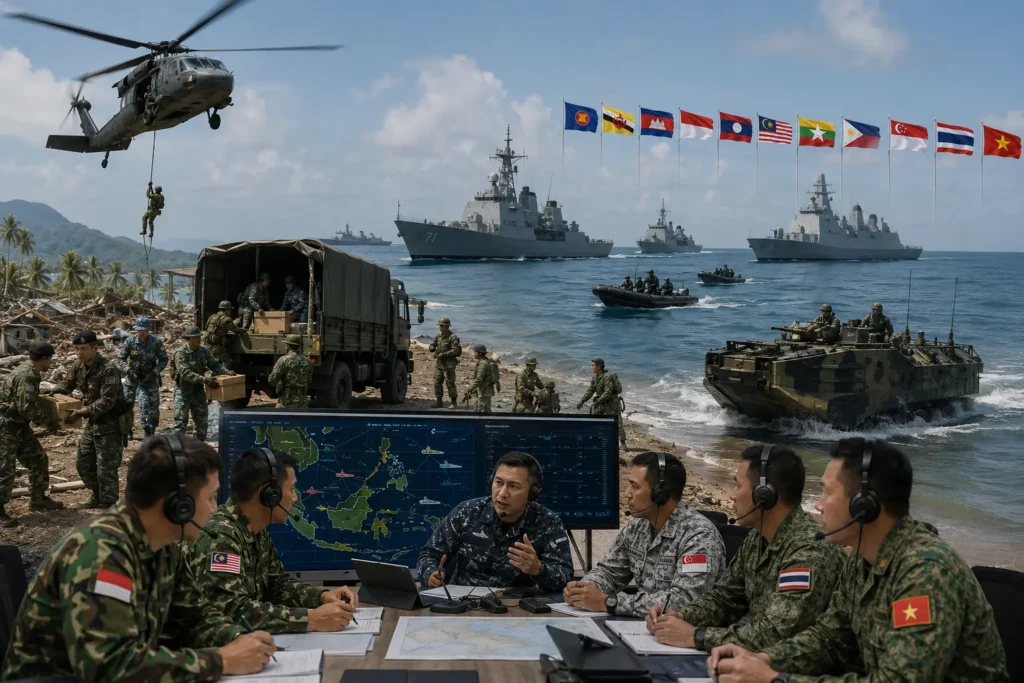
Military cohesion in ASEAN is traditionally multilateral – focused on non-traditional security (disaster relief, piracy, counter-terrorism) – and English underpins growing interoperability. Joint exercises, such as the ASEAN Solidarity Exercise (ASEX) and AMNEX (ASEAN Multilateral Naval Exercise), rely on English for command, control, and coordination.
English proficiency among officers – bolstered by exchanges, training in Anglophone countries (US, Australia, UK), and joint academies – enables shared doctrines, intelligence coupling, and humanitarian assistance. This is vital against gray-zone tactics in the South China Sea, where China employs divide-and-rule strategies.
While ASEAN avoids formal alliances, English-mediated dialogues in the ASEAN Regional Forum (ARF) and ADMM-Plus (ASEAN Defense Ministers’ Meeting) enhance confidence-building. Such groups and activities also support partnerships with external powers, balancing Chinese influence without alienating members. Proficiency gaps remain a challenge, but targeted education programs address them.
The Bond That Promotes Freedom

English education is more than a skill-building endeavor; it is a strategic asset forging ASEAN cohesion across political, economic, and military domains. In an era of great-power competition, it equips the region to squelch China’s ambitions, preserving autonomy and promoting stability. Sustained investment will determine whether ASEAN evolves into a more resilient counterweight, embodying “unity in diversity” against hegemonic pressures. Future research should empirically quantify English proficiency’s impact on specific integration outcomes.