

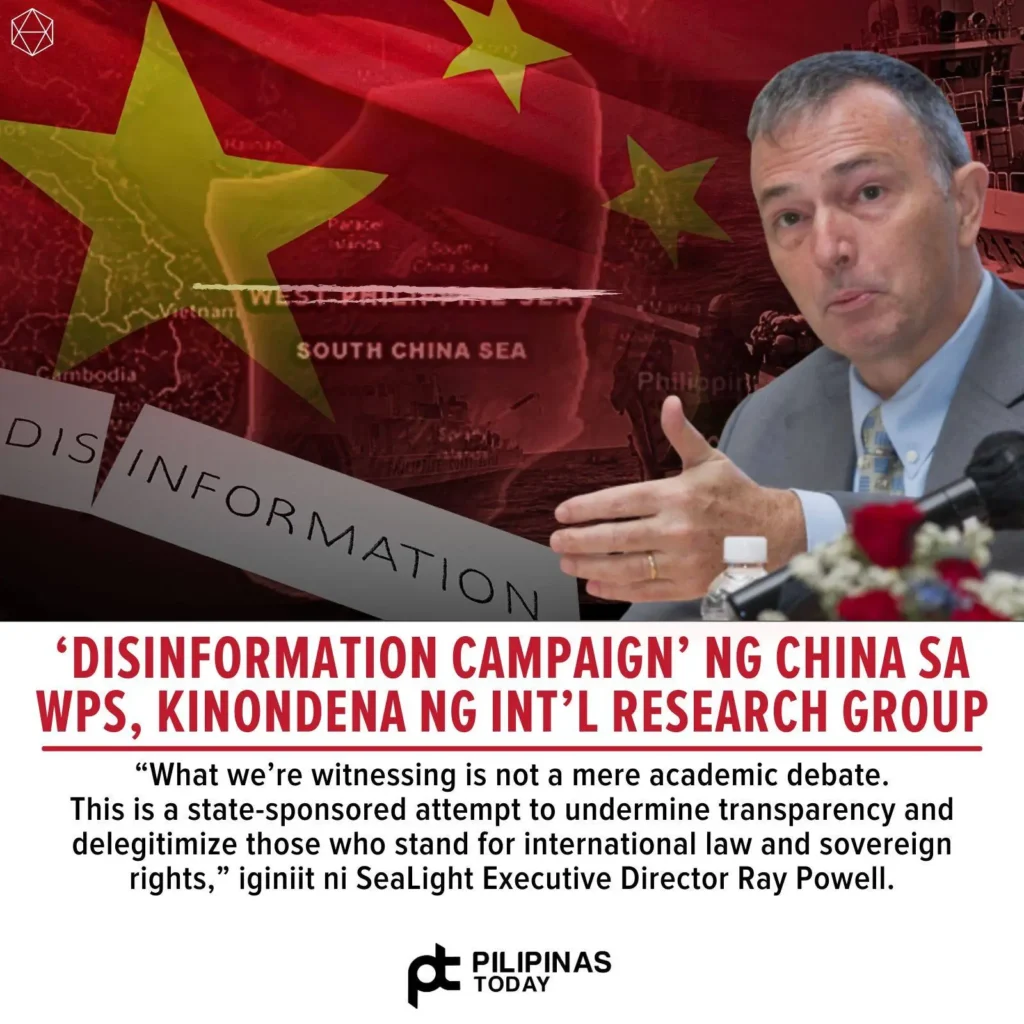
MANILA — Col. Powell, a 35-year veteran who served in the Philippines and held key attaché posts at US embassies within Southeast Asia, has used open-source documentation (photographs, videos, AIS tracking, and incident logs) to illuminate what he and Philippine officials describe as systematic Chinese efforts to assert de facto control over Manila’s exclusive economic zone (EEZ), recognized under the 2016 Permanent Court of Arbitration ruling. His work with SeaLight (sealight.live), building on earlier Stanford-based Gordian Knot Center projects, has catalogued water-cannon attacks, blocking maneuvers, swarming tactics, and interference with legitimate Philippine activities.
Rather than rebut specific evidence with credible counter-data, the Chinese Embassy in Manila and aligned state media have responded with a coordinated campaign of public smears, social-media barrages, and opinion pieces that personally target Powell. Most reviewers describe the language as condescending, dismissive, and at times threatening in tone, amounting to what some observers and Powell himself have characterized as an attempt to intimidate and discredit an “inconvenient harbinger of truth”.
Personal Attacks from the Embassy
Since at least 2025, under Ambassador Jing Quan and Deputy Spokesperson Guo Wei, the embassy has issued multiple statements attacking Powell and SeaLight. In one widely circulated Facebook and X post (both banned in China, by the way), Guo Wei declared: “There is nothing new in Ray Powell’s anti-China rhetoric. He travelled all the way across the Pacific to Manila to propagate yet more misleading narratives. The question is, why now?” The statement accused Powell of inserting himself “into every critical moment, selectively curat[ing] information, and amplif[ying] the ‘China threat’ narrative,” while noting his background as a former U.S. military officer.
In its January 2026 response to a SeaLight investigation into Beijing’s direction of Manila’s Chinese-language media, the embassy accused Powell and his organization of “inciting ‘hatred,’ spreading ‘smears,’ and attempting to ‘sabotage’ China-Philippines relations.” It attacked the messenger rather than disputing the documented coordination between the embassy and local Mandarin outlets. Ambassador Jing Quan warned that those spreading what China deems “misinformation” would “pay the price” and vowed to “push back firmly without hesitation.”
Chinese state media amplified the personal dimension. In a February 26th China Military / China Daily piece titled “Beware of the ‘bad apples’ in China-Philippines relations,” author Gong Rong labeled Powell the head of a “so-called transparency project” operating under the “guise of a ‘non-profit leader.’” It erroneously claimed he had “long accepted funding from external forces,” coordinated with Philippine Coast Guard spokesperson Commodore Jay Tarriela, and formed a “collusive network” of “hype, organizational endorsement, and external echo.” Powell was portrayed as a “pawn for external interference” who fabricates reports and distorts China’s “lawful actions” into sovereignty infringements.
These attacks go beyond policy disagreement. The embassy has framed Powell’s presence and reporting as foreign meddling aimed at Filipino audiences, while simultaneously directing or echoing content in local Chinese-language media (United Daily News, Chinatown News TV, etc.) that denies or downplays incidents involving fisherfolk and patrol vessels. Powell has documented how identical embassy-drafted columns appear verbatim across multiple outlets.
Juvenile Insults and Veiled Threats
Philippine and international observers have noted the childish, schoolyard quality of some embassy rhetoric, mocking Powell’s long-standing regional engagement as if he were a transient opportunist (“travelled all the way across the Pacific”), repeatedly questioning his raison d’etre. This despite years of vetted output and presentation of complex maritime evidence using primary data sources of vessel tracks, timestamps, and visual verification. The “bad apples” framing and “guise of a non-profit leader” language carry a sneering, ad hominem edge more typical of propaganda than diplomacy.
More concerning are the implied threats to personal and professional safety. Warnings that critics will “pay the price,” face “firm response… without hesitation,” or are engaged in “bullying” and “intimidation” (a charge the embassy leveled at SeaLight while itself mounting barrages against Philippine officials and researchers) create a chilling atmosphere. In the broader context of CCP influence and united-front operations, such public targeting by a foreign embassy can invite online harassment, reputational attacks via pro-Beijing networks, or worse. Powell, an American ally operating in and reporting on the Philippines, has chosen to remain in the crosshairs rather than retreat.
Taking On the Echo Chamber
What makes Powell’s stance notable is that he is not Filipino. As a retired U.S. military officer with deep regional experience, he could have pursued comfortable consulting or academic roles far from the fray. Instead, he has embedded transparency efforts in Manila’s information space, published columns in outlets like the Philippine Daily Inquirer (“Attacking the Light, Defending the Darkness: Beijing’s Echo Chamber in Manila,” January 23, 2026) and other local news outlets, testified before the U.S. Senate on PRC gray-zone activities, and maintained a steady drumbeat of evidence-based reporting.
His work directly serves average Filipinos, particularly the thousands of fisherfolk whose traditional grounds around Scarborough Shoal and other maritime features have become high-risk zones due to CCG and militia presence. By exposing both the harassment and the parallel influence campaign (United Front-linked organizations, coordinated media, economic leverage), Powell highlights a clear danger: if Philippine officials or elites grow complacent or financially entangled with Beijing-linked projects, the result could be accelerated de facto loss of sovereign rights in the WPS. That would mean not simply abstract maps but concrete losses such as livelihoods, food security, endangered resource revenues, as well as the ability of future generations to operate freely in waters awarded to the Philippines – and other ASEAN countries – under international law.
Pro-Beijing voices in Manila’s Chinese-language press and some English opinion columns have echoed embassy talking points, often framing transparency advocates as warmongers or U.S. proxies while downplaying verified incidents. Powell’s persistence disrupts that narrative and provides solid support for officials like Secretary of National Defense, Gilbert Teodoro, himself a staunch, longtime opponent of Chinese overreach.
Stakes of Transparency
The Chinese Embassy’s campaign against Powell is not an isolated spat; it fits a pattern of aggressive pushback against any independent illumination of its WPS/SCS activities. By choosing substance over propaganda, Powell and SeaLight have forced Beijing to respond – and in doing so – revealed the limits of its contrived echo chamber.
For Filipinos watching their maritime frontier erode incident by incident, the question is not whether one American veteran should speak up. It is whether their own institutions and media will match that transparency before complacency or quiet influence renders the 2016 arbitral victory a dead letter. Powell’s reporting suggests the cost of silence could be measured in boarded boats, political hostage-taking, displaced fishers, and a permanently altered cartography of the waters surrounding the entire archipelago; a fate that no Filipino patriot – or ASEAN member country – could possibly want.