
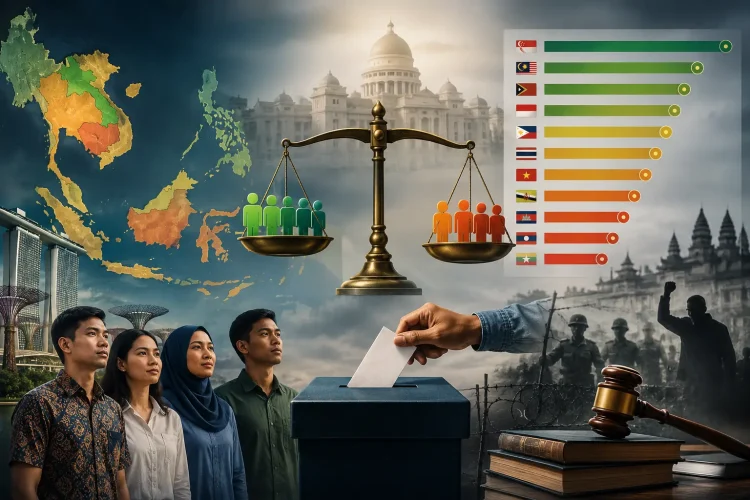
The Scores
An ascending rating system evaluates countries not only with absolute numbers but on their position within regional hierarchies and year-over-year or multi-year trends, emphasizing improvements in electoral pluralism, civil liberties, government functioning, and political participation. Primary sources include the EIU Democracy Index (0-10 scale: full democracy >8, flawed 6-8, hybrid 4-6, authoritarian <4), Freedom House (0-100: Free, Partly Free, Not Free), and V-Dem’s Liberal and Electoral Democracy Indices.
First, it must be noted that, in the latest EIU assessments (2024-2025 data), no ASEAN member qualifies as a full democracy. Malaysia consistently ranks highest among core members, often as a “flawed democracy” with scores around 7.0-7.1 (global rank ~44 in recent reports), benefiting from competitive elections, a vibrant – though constrained – civil society, and judicial assertiveness. It edges out others due to post-2018 reforms that broke long-term, single-coalition dominance.
Indonesia follows closely as a flawed democracy/electoral democracy (scores ~6.4-6.6), praised for large-scale elections and pluralism post-Suharto but facing backsliding concerns under recent leadership. Singapore performs well on governance and stability, but scores lower on political freedoms (hybrid regime). The Philippines has fluctuated, often flawed with dynastic rivalries and past populist governance. Thailand, despite elections, remains constrained by military and monarchical influences (often hybrid or lower). Brunei, Cambodia, Laos, Myanmar, and Vietnam rank as authoritarian or hybrid, with severe restrictions on opposition and media.
V-Dem and Freedom House data reinforce this hierarchy: Malaysia shows resilience through coalition-building and anti-corruption efforts, while Indonesia maintains broad participation despite institutional erosion. Myanmar’s post-2021 coup collapse places it at the bottom. This ascending lens reveals Malaysia’s edge in institutional openness and Indonesia’s in scale of democratic practice, though both face populist and dynastic pressures threatening gains.
Standout Officials
- Anwar Ibrahim (Malaysia, Prime Minister since 2022): A central reformist figure, Anwar rose through the Reformasi movement after his 1998 ouster. His government emphasizes anti-corruption, judicial independence, cross-ethnic coalitions (i.e., unity government), and incremental reforms like party financing transparency and administrative capacity-building. While critics note slow progress on core issues like sedition laws and ethnic policies, Anwar symbolizes a shift toward more competitive, accountable politics. His leadership has helped Malaysia maintain or modestly improve ratings amid regional declines.
- Prabowo Subianto (Indonesia, President since 2024): A former general with a complex human rights legacy, Prabowo’s election marked a dynastic turn (as son-in-law of Suharto). His administration has faced criticism for military role expansions in civilian affairs, perceived favoritism, and actions seen as consolidating power, contributing to democratic concerns in EIU and V-Dem reports. Supporters highlight continuity in economic populism and stability; detractors warn of risks to pluralism and accountability.
Notables on the downward scale side include Philippine figures relative to the ongoing Marcos-Duterte family feud that is negatively affecting governance, and Thailand’s shifting prime ministers amid military oversight. These individuals illustrate how personal and dynastic politics intersect with institutional quality.
Political Future of the Bloc
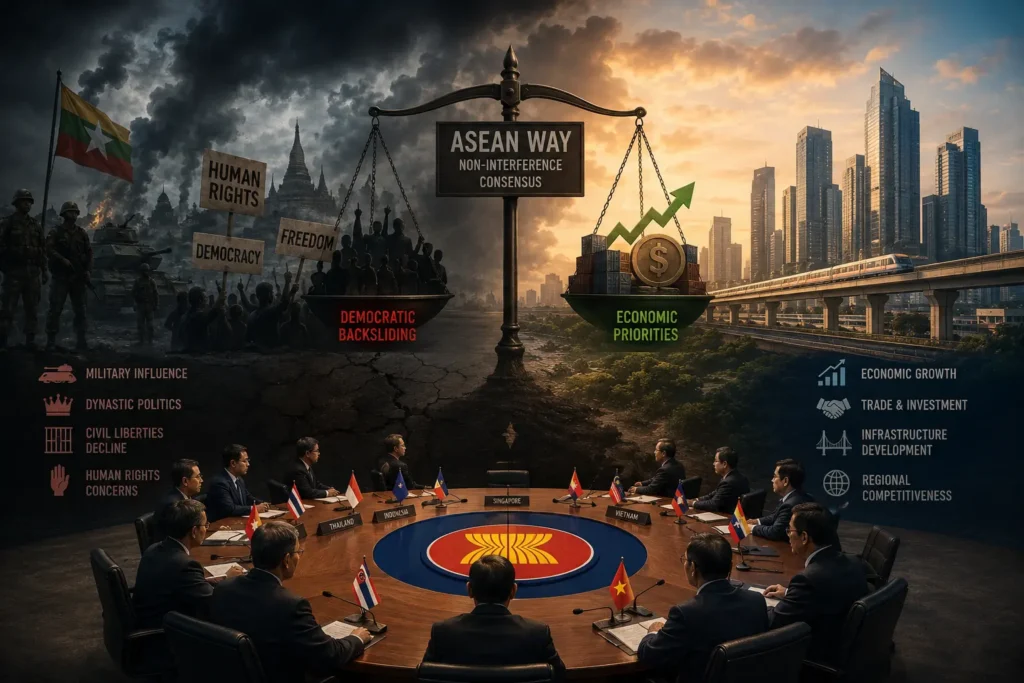
The consensus-based “ASEAN Way” policy prioritizes non-interference, limiting collective action on internal democratic deficits (i.e., the Myanmar crisis). Politically, the bloc faces headwinds: rising dynastic politics (Indonesia, Philippines, Thailand), military influence, and economic priorities often trumping human rights. Regional EIU scores have declined for years, with backsliding in civil liberties and government functioning observed.
Optimistic scenarios hinge on Malaysia’s reform model inspiring neighbors, and Indonesia leveraging its size for positive “Teladan” (Bahasa Indonesia for being a role model) / “Shi Fan” (示范 – setting the example, used among the country’s powerful ethnic Chinese merchant class) effects, alongside Timor-Leste’s democratization infancy. External partnerships with Western democratic powers could incentivize openness. Pessimistic outlooks point to further erosion under authoritarian-leaning leaders, geopolitical hedging with China, and internal fragmentation.
Overall, ASEAN’s future likely remains hybrid: economic integration advancing while political democracy stagnates or regresses unevenly. Sustained gains require domestic reforms prioritizing rule of law, independent institutions, and reduced military/dynastic dominance. Without them, the bloc risks widening internal divergences that undermine cohesion.
Authoritarian Tendencies
As mentioned above, Malaysia leads in relative democratic quality per ascending ratings, followed by Indonesia, due to electoral competitiveness and reform efforts. Standouts like Anwar Ibrahim highlight potential for progress, even as figures like Prabowo underscore vulnerabilities.
The bloc’s political horizon is cautious, marked by resilience in pockets but broader challenges from populist movements and non-interference norms. Academic and policy attention should focus on supporting incremental, context-sensitive democratization to bolster long-term stability and prosperity. Further empirical tracking via updated indices will be essential.
A thoughtful and data-driven analysis that goes beyond political headlines to examine how democracy is actually measured across ASEAN. By comparing institutions, civil liberties, and governance outcomes, the article provides valuable context for understanding the region’s diverse political landscape. Whether you’re interested in politics, public policy, or Southeast Asia’s future, this is an engaging and insightful read that challenges assumptions and encourages deeper discussion.