
Preference Falsification
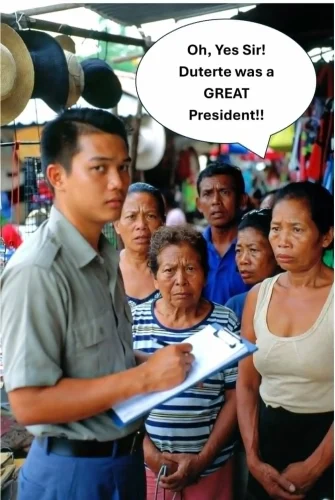
Public opinion research assumes those answering surveys provide truthful input when assured of confidentiality. In environments characterized by political repression, surveillance, or clientelism, this assumption falters. Timur Kuran’s concept of “preference falsification” explains how individuals publicly align with dominant narratives while privately holding dissenting views to avoid social or state rancor.
In Southeast Asia, many ASEAN states feature hybrid regimes or one-party dominance with varying degrees of press freedom and judicial independence. Polling firms often rely on face-to-face interviews due to limited digital penetration or infrastructure challenges, conducted in public venues for logistical efficiency. This setup amplifies biases compared to anonymous, private, individual interviews common in consolidated democracies.
Social Desirability Bias
Social desirability bias (the tendency for people to answer survey questions or behave in ways that make them look good to others) occurs when respondents tailor answers to align with perceived social norms or avoid judgment. In political contexts, this manifests as overreporting support for incumbents or underreporting criticism.
In authoritarian or semi-authoritarian settings, the bias intensifies due to fear of retribution. Respondents may perceive surveyors as linked to authorities, especially in group settings where peers overhear responses. Public spaces like food markets exacerbate this: visibility to officials, neighbors, or elites heightens self-censorship. Group questioning further pressures conformity through social monitoring.
Country-Specific Analyses
The Philippines
The Philippines maintains a relatively dense polling environment through firms like Social Weather Stations (SWS) and Pulse Asia, using face-to-face household, open spaces and multi-stage probability sampling. Surveys are often conducted in communities, mostly with public elements.
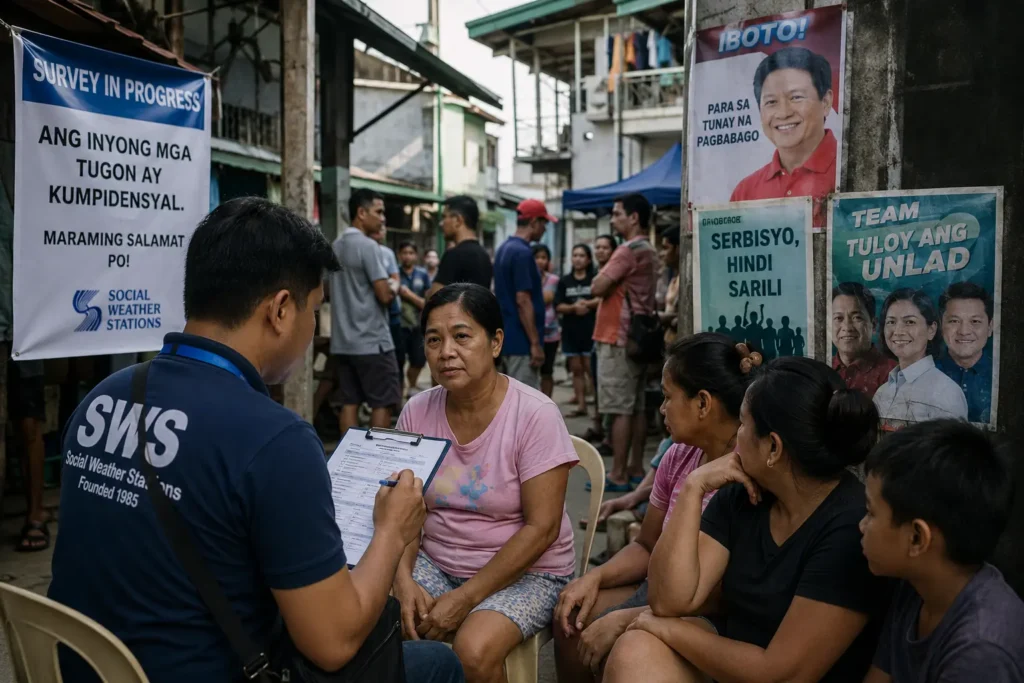
Critics question accuracy amid accusations of bias, bandwagon effects, or over/underrepresentation of sectors. In a context of political polarization, dynastic politics, and occasional threats to critics, respondents may hesitate to voice anti-incumbent views openly, especially in group or visible settings. While more independent than its neighbors, the hybrid democratic environment still fosters self-censorship, particularly on sensitive issues like corruption, poverty, or elite influence.
Vietnam, Cambodia, and Laos
These one-party or dominant-party states present starker challenges. Independent polling is limited or state-influenced. In Vietnam and Laos, surveys often occur under government oversight or in community settings tied to local authorities. Cambodia has seen restrictions on civil society and opposition, making open criticism risky.
Face-to-face public or semi-public interviews in markets or villages likely suppress genuine discontent over governance, corruption, or rights. High reported trust in government in some regional data may reflect bias rather than reality, as preference falsification thrives where dissent carries clear risks. Limited use of anonymous methods or list experiments compounds inaccuracies.
Indonesia
As the region’s largest democracy, Indonesia features competitive elections and active polling. However, challenges persist, including vote-buying, social media disinformation, and regional variations (i.e., Papua). Surveys may involve community-based collection where social pressures or elite influence affect responses.
Democratic backsliding concerns and self-censorship on certain issues (religion, ethnicity) can distort results. Public collection methods risk amplifying conformity, particularly in conservative or clientelist areas.
Comparative Impacts
Across these countries, public/group methods contrast with private, individual, anonymous protocols that better elicit honest responses. Studies on social desirability in Asia highlight cultural emphases on harmony with extant authority, amplifying biases.
Consequences are:
- Overestimation of regime support.
- Underestimation of grievances (e.g., inequality, corruption).
- Policy miscalibration by elites.
- Erosion of polling credibility, fueling skepticism or “post-truth” narratives.
Regional surveys by ISEAS and Pew using face-to-face methods in some countries note similar caveats, though they often target elites less prone to bias.
Recommendations for Improved Methodological Rigor
- Prioritize Privacy: Shift to private, individual interviews where feasible; use digital tools (secure websites and apps) for anonymity in urban areas.
- Indirect Techniques: Expand list experiments, endorsement experiments, or randomized response techniques for sensitive political questions.
- Mixed-Mode Sampling: Combine face-to-face with phone/online where infrastructure allows, with careful weighting.
- Transparency and Validation: Pollsters should disclose exact collection contexts (public/private, individual/group) and margins for bias. Cross-validate with behavioral data or list experiments.
- Capacity Building: International collaboration to train local researchers while respecting sovereignty; support independent institutions.
- Contextual Adaptation: In high-risk environments, partner with trusted NGOs or use ethnographic supplements.
Work needed to Avoid Bias
Political polling in the Philippines, Vietnam, Cambodia, Laos, and Indonesia frequently yields inaccurate portraits of public sentiment due to collection methods incompatible with weak rule-of-law environments. Public spaces, group dynamics, and visible processes undermine anonymity, encouraging preference falsification over candid expression.
Addressing these requires methodological innovation and greater awareness of contextual biases. Without such reforms, polling risks serving as a tool of legitimation rather than illumination, hindering genuine democratic accountability and responsive governance in ASEAN. Future research should empirically test bias magnitudes through validation studies tailored to the region.
This was a fascinating read. Too often, poll numbers are treated as unquestionable facts, but this article reminds us that surveys are only as good as their methodology and assumptions. As a regular citizen, it’s refreshing to see a deeper discussion about how public opinion is measured and how narratives can be shaped by flawed interpretations of data. A timely reminder to look beyond the headlines and think critically about the information we’re presented with.