
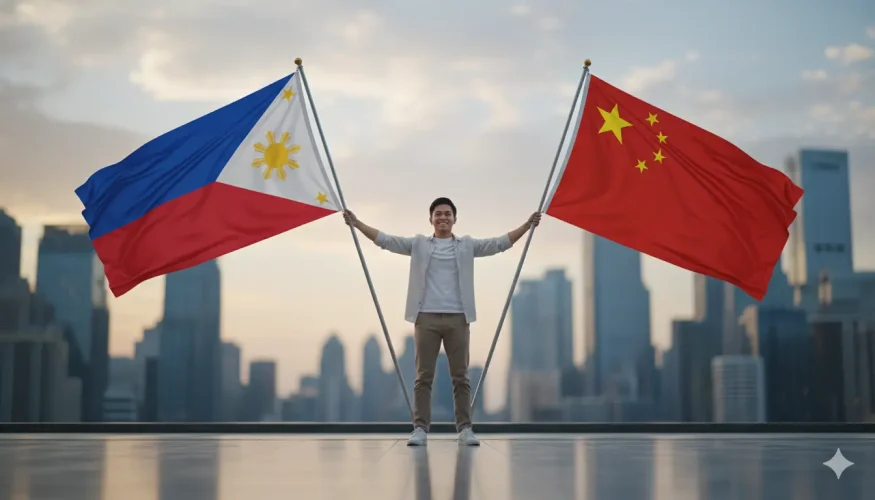
Who are you?
Chinese-Filipinos, commonly known as Chinoys or Tsinoys (a portmanteau of “Tsinong Pinoy”), represent one of the most economically influential yet sociologically complex ethnic minorities in Southeast Asia.
Predominantly descendants of Hokkien-speaking migrants from Fujian province in southern China, they form a diaspora bloc community that has shaped Philippine commerce and politics since the end of World War II. Yet their identity remains layered and often ambivalent: legally Filipino citizens by birth or naturalization, culturally hybrid, but strategically presented as “Chinese” in interactions with foreigners.
Understanding the sociological roots of this dual (or selective) identification, the outsized economic role of prominent Hokkien-descended families, and how the Duterte administration’s foreign-policy pivot toward Beijing fostered a renewed sense of acceptance from the ancestral homeland that now seems to be eroding their Philippine roots is essential when analyzing the country.
Historical and Structural Foundation of Identity Ambivalence
Chinese migration to the Philippines dates back centuries, with Hokkien traders (often called “Sangley” under Spanish rule) arriving as early as the 16th century to engage in the galleon trade. Colonial policies restricted their rights, confining them to segregated districts and barring land ownership, which paradoxically encouraged commerce and capital accumulation. Post-independence, especially under the Marcos Sr. era, mass naturalization in the 1970s integrated many into Philippine society, granting citizenship and accelerating assimilation. Yet full social belonging has remained elusive.
Sociologically, this reflects classic patterns of middleman minority dynamics (as theorized by Stanford Researcher Dr. Edna Bonacich): an entrepreneurial ethnic group that fills economic niches between rulers and the masses, generating both prosperity and resentment. Tsinoys have preserved strong in-group institutions like Chinese-language schools, temples, clan associations (tongs), and Hokkien as a home language, which reinforce ethnic solidarity and transnational networks. At the same time, intermarriage, Catholicism (or Protestantism), and fluency in Tagalog/English have produced a distinctly “Chinoy” culture, neither fully mainland Chinese nor indistinguishable from the indigenous Filipino “Malay” majority.
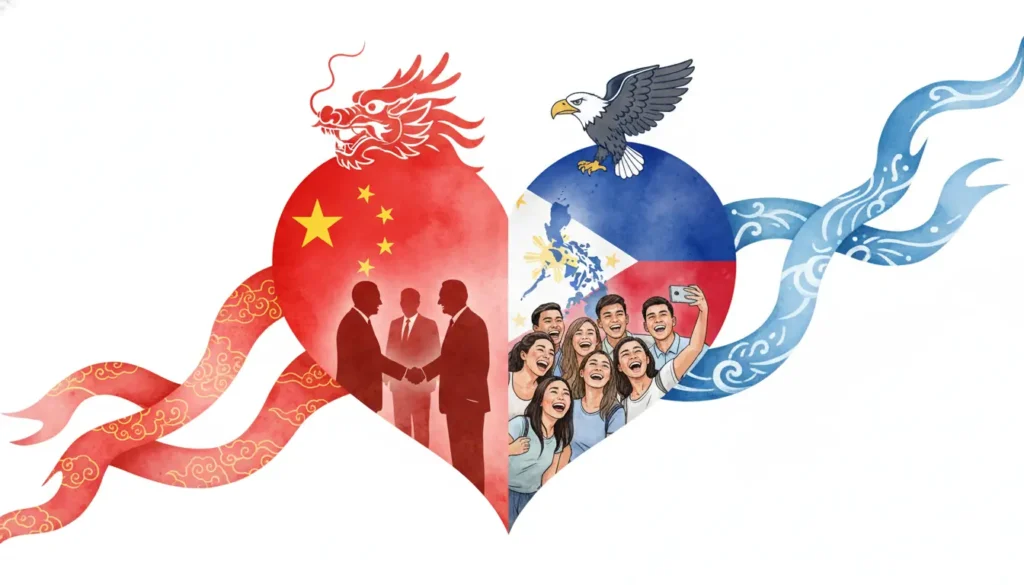
Many Tsinoys describe themselves as “Chinese by blood, Filipino by heart.” Younger generations increasingly prioritize Filipino nationality, yet older cohorts or business elites may foreground Chinese ethnicity when interacting with Westerners. This selective self-presentation serves pragmatic and psychological functions.
To Western investors or partners, emphasizing “Chinese” roots signals access to guanxi (relationship-based) networks across the global Chinese diaspora, evokes stereotypes of disciplined entrepreneurship, and distinguishes the speaker from broader Filipino identity narratives often associated with colonial legacies or economic underdevelopment in Western eyes.
In diaspora studies, this hybridity aligns with University of Western Australia’s Professor Dr. May len Ang’s concept of “not speaking Chinese” yet claiming it: identity is performative, context-dependent, and never total. Tsinoys navigate what sociologists call “segmented assimilation,” succeeding economically while retaining cultural distinctiveness rather than fully melting into the host society.
Hokkien Diaspora and Economic Hegemony
A defining feature of Chinoy sociology is the disproportionate economic influence relative to their small population share (roughly 1–2% of the country). Hokkien-descended families dominate key sectors such as retail, real estate, banking, manufacturing, aviation, and food processing. This is not conspiracy but the outcome of ethnic entrepreneurship – trust-based family firms, rotating credit associations, and early-mover advantages in trade.
Prominent illustrations include:
- The Sy family(Henry Sy Sr. and heirs: Henry Jr., Hans, Herbert, Harley, Teresita Sy-Coson, Elizabeth Sy), founders of the SM Group. Henry Sy, who arrived from Fujian as a child, built the Philippines’ largest mall empire, BDO Unibank (the country’s biggest bank), and vast real-estate holdings. Their model exemplifies vertical integration from retail to finance.
- The Gokongwei family(John Gokongwei Jr. and heirs, including Lance Gokongwei), controllers of JG Summit Holdings, Robinsons Malls and supermarkets, Cebu Pacific Air, and petrochemicals. Gokongwei started in corn trading and became a classic industrial challenger to entrenched monopolies.
- Lucio Tan(LT Group), whose empire spans Fortune Tobacco, Philippine Airlines (acquired in the 1990s), banking, and beverages.
- Others like Andrew Tan(Alliance Global Group and Megaworld real estate), Tony Tan Caktiong (Jollibee Foods, Southeast Asia’s largest fast-food chain), and the Co family (Puregold supermarkets).
Forbes lists consistently rank these families among the Philippines’ wealthiest; their conglomerates control malls that function as de facto town centers, airlines that democratized travel, and banks that finance small businesses. This concentration stems from Hokkien cultural emphasis on education, thrift, and family enterprise, amplified by historical exclusion from agriculture that funneled talent into commerce.
Yet it also fuels perceptions of economic and political “control,” echoing Yale Law School Professor Amy Chua’s “market-dominant minority” thesis and occasional populist backlash. Despite these families employing millions, driving GDP growth, and having Philippine roots spanning generations, they remain distrusted and held in disdain by the Filipino majority, with notables like Alice Guo and Zaldy Co displayed as examples.
Beijing’s Embrace Under Duterte
The Duterte regime’s 2016–2022 “pivot to China” marked a seismic shift in Philippine foreign policy, moving away from traditional U.S. alliance toward economic engagement with Beijing. Duterte’s state visits to China, accompanied by large business delegations (including many Chinoy leaders from the Federation of Filipino-Chinese Chambers of Commerce and Industry), downplayed South China Sea disputes in favor of infrastructure deals, trade, and Belt and Road Initiative (BRI) opportunities.
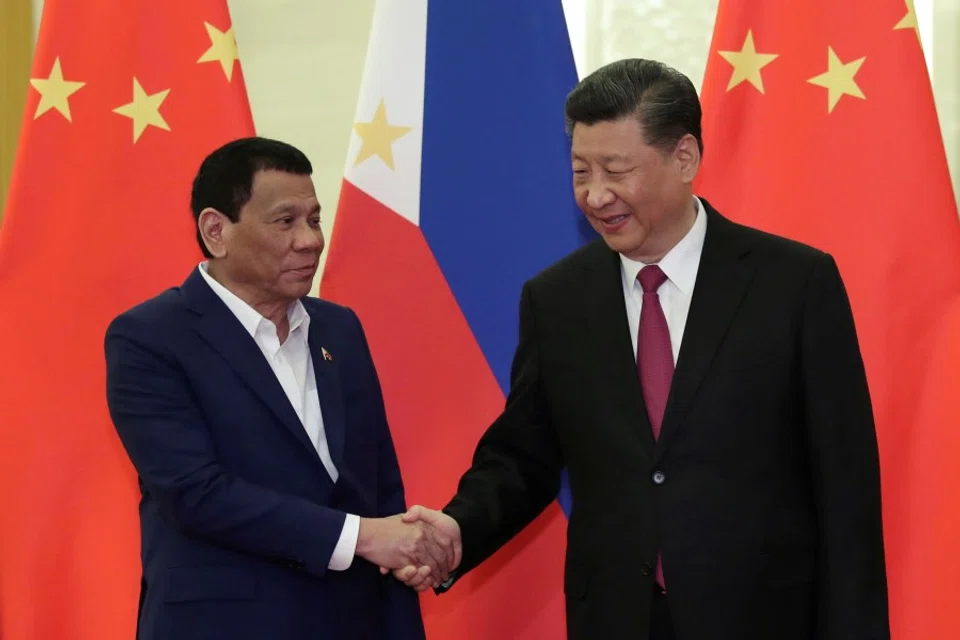
For Tsinoys, this pivot brought tangible and symbolic benefits. Beijing’s overseas Chinese policy, managed through the United Front Work Department and Overseas Chinese Affairs Office, courts huaren (ethnic Chinese abroad) regardless of citizenship as cultural and economic bridges, but also for political influence in other countries.
Improved bilateral ties eased visa processes, boosted trade, and opened doors for Chinoy conglomerates to partner on projects or expand supply chains with mainland firms. Families already fluent in Hokkien and networked across the diaspora found renewed validation: Beijing no longer framed them as traitors to the motherland for settling in a Western-aligned country, but as part of the extended “Chinese nation.” This “new acceptance” reduced the psychological distance many felt toward the ancestral homeland, especially after decades of Cold War-era suspicion and post-1989 isolation.
Sociologically, the pivot illustrated how state-level geopolitics reshapes minority identities. Duterte’s pro-China rhetoric tempered domestic Sinophobia, framing economic cooperation as national interest. Chinoy businesses gained from increased Chinese tourism, investment, and relaxed regulatory environments for certain sectors. Windfalls from POGO’s (Philippine Online Gaming Operators) were, and continue to be, immense.
Political loyalty remained anchored in the Philippines. Chinoys largely supported the pivot pragmatically but not necessarily ideologically. The era underscored transnationalism – identities are not zero-sum but responsive to power shifts between host country, homeland, and global capital.
During the subsequent Marcos administration, which recalibrated toward the U.S., the fluidity of such alignments became strained. For Tsinoys, the Duterte years reinforced a comfortable hybridity: Filipino citizens with Chinese heritage who can leverage both for economic and cultural capital. That “congenial sea” turned more turgid under Marcos, forcing the Chinoys to rely on foundational Malay-Filipino proxies to promulgate their agendas, as made public by the above-mentioned Manila Times pieces and recent increases in pro-China social media.
Beyond Binary Belonging
The Chinoy experience challenges simplistic notions of national identity. They are Filipino citizens who have built the Philippines’ commercial backbone, yet their Hokkien roots and economic successes sustain a distinct ethnic consciousness. Selective emphasis on “Chinese” identity to Western audiences reflects strategic cosmopolitanism rather than disloyalty. The Duterte pivot amplified this by aligning state policy with diaspora aspirations, granting Beijing’s embrace without requiring renunciation of Philippine allegiance.
Ultimately, Tsinoys embody the promise and tensions of globalization: a model of ethnic entrepreneurship and cultural hybridity that enriches the host society while navigating external perceptions. Their story invites broader reflection on how minorities in multi-ethnic states negotiate belonging amid economic power and geopolitical flux. In an era of rising China and shifting Southeast Asian alliances, the Chinoy case remains a living laboratory for understanding identity in motion.